
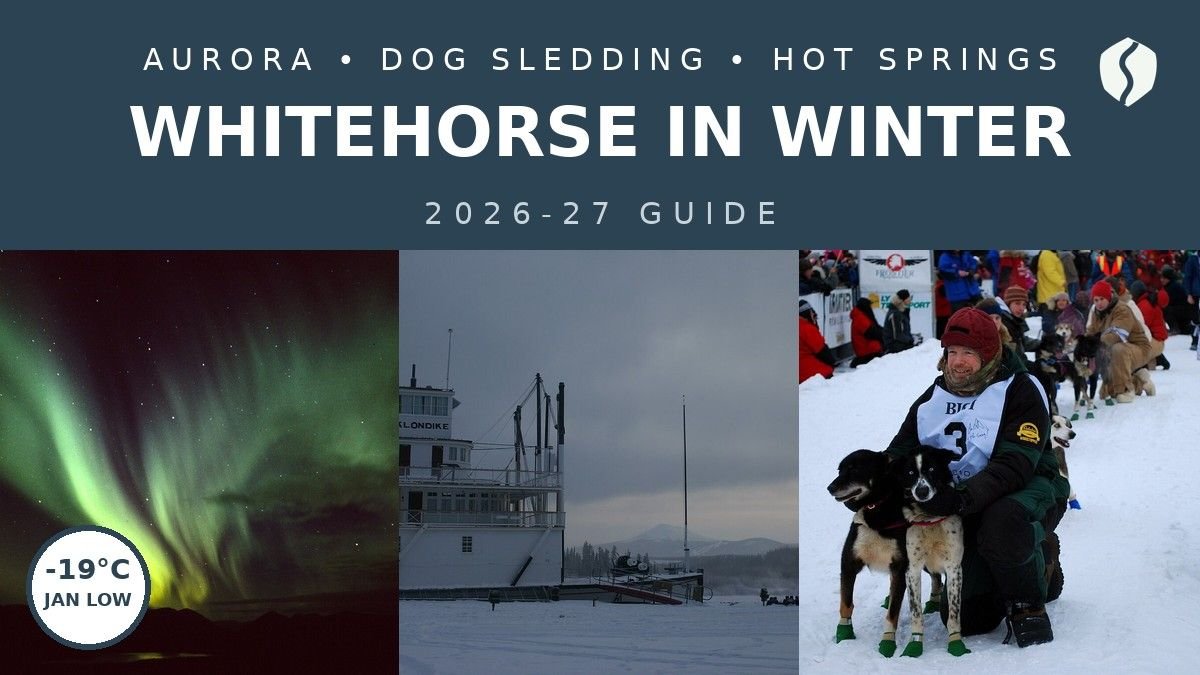
- ✓ Whitehorse winter is a small-city trip with big-country nights: you sleep in a real town with restaurants and museums, then drive 20 minutes out of the streetlights and stand under the aurora.
- ✓ The cold is the point, and it is manageable: January days run around −13°C with lows near −19°C, and only about 6–7 hours of daylight — dress for −30°C, plan your days around the short light, and save the long nights for the sky.
- ✓ All prices here are planning ranges, not quoted rates: dog-sled tours, aurora tours and hot-springs passes change by operator and season, so check the official sites linked below for your exact dates.
Here is the thing nobody tells you about Whitehorse in winter: it feels less like a holiday destination and more like a place that is getting on with its own life while you happen to be visiting. I arrived in January, stepped off the plane into air so cold it made my nose hairs freeze — a sensation I had read about, laughed at, and then immediately stopped laughing about — and drove into a small city of about 28,000 people where the streets were plowed, the cafés were warm, and the mountains sat white on every horizon. By 4:30 in the afternoon it was dark. By 10 at night I was standing on Fish Lake Road in −28°C, watching green light ripple across the sky, and I understood why people fly to the Yukon in the middle of winter on purpose.
What follows is the trip I actually did over four days: two aurora nights, one dog-sled morning, one hot-springs afternoon, and the daytime hours filled with a canyon walk, a sternwheeler in the snow, museums, and the wildlife preserve. Every price below is an approximate planning range in Canadian dollars for 2026–27. I double-checked the hot springs, the wildlife preserve, the MacBride Museum and the SS Klondike on their official sites before writing this, and you should do the same for your dates, because winter hours and tour availability up here change with the season and the weather in a way that a summer trip does not.
The stops on the map
Eight stops: two out on Fish Lake Road for the aurora and the dogs, the hot springs and the wildlife preserve on Takhini Hot Springs Road, and four in or near town. Tap any stop to jump the map straight to it.
Map data © OpenStreetMap contributors. Open the full map
First, how cold — and how dark — is it really?
Let us get the numbers out of the way, because Whitehorse winter has a reputation problem in one direction only: people assume it is uninhabitable, and then they are surprised by how normal it feels once they are dressed for it. January in Whitehorse averages a daytime high around −13°C and a nighttime low around −19°C, and the city sits in the rain shadow of the Coast Mountains, so it is famously dry — Whitehorse is often called Canada’s driest city, and the snow is the light, powdery kind rather than the wet, heavy kind. Cold snaps below −40°C do happen, and I will not pretend −28°C at Fish Lake felt like a fun fact. It felt like my face was being politely but firmly told to go inside. The trick is that everything here is built for it: heated buildings, plugged-in cars, and a whole town that does not cancel itself because it is cold.

The darkness is the bigger adjustment, and it is also the whole reason to come. In December, Whitehorse gets under 6 hours of daylight a day; in January, roughly 6–7 hours, with sunrise around 10–11 in the morning and sunset before 5 early in the month. That sounds bleak until you flip it around: the long night is when the aurora happens, and a city where it is dark by late afternoon gives you an aurora window that starts at dinner time instead of midnight. I planned my days the way locals seem to: outdoors in the short bright middle of the day, indoors for the late afternoon, and back outside after dark for the sky.
Book at least three nights, and treat the aurora like weather, not like a show with a start time. I saw nothing on my first night (cloud, and I had gone to bed too early), a faint green smudge on the second, and the full rippling curtains on the third. Three nights is the minimum honest bet; four nights, which is what this guide uses, is better. Our companion guides to where to see the northern lights in Canada and the best time to see them explain why Whitehorse ranks so high: it sits under the auroral oval, and the dry air means clearer skies than many northern towns.
The aurora: get out of the streetlights
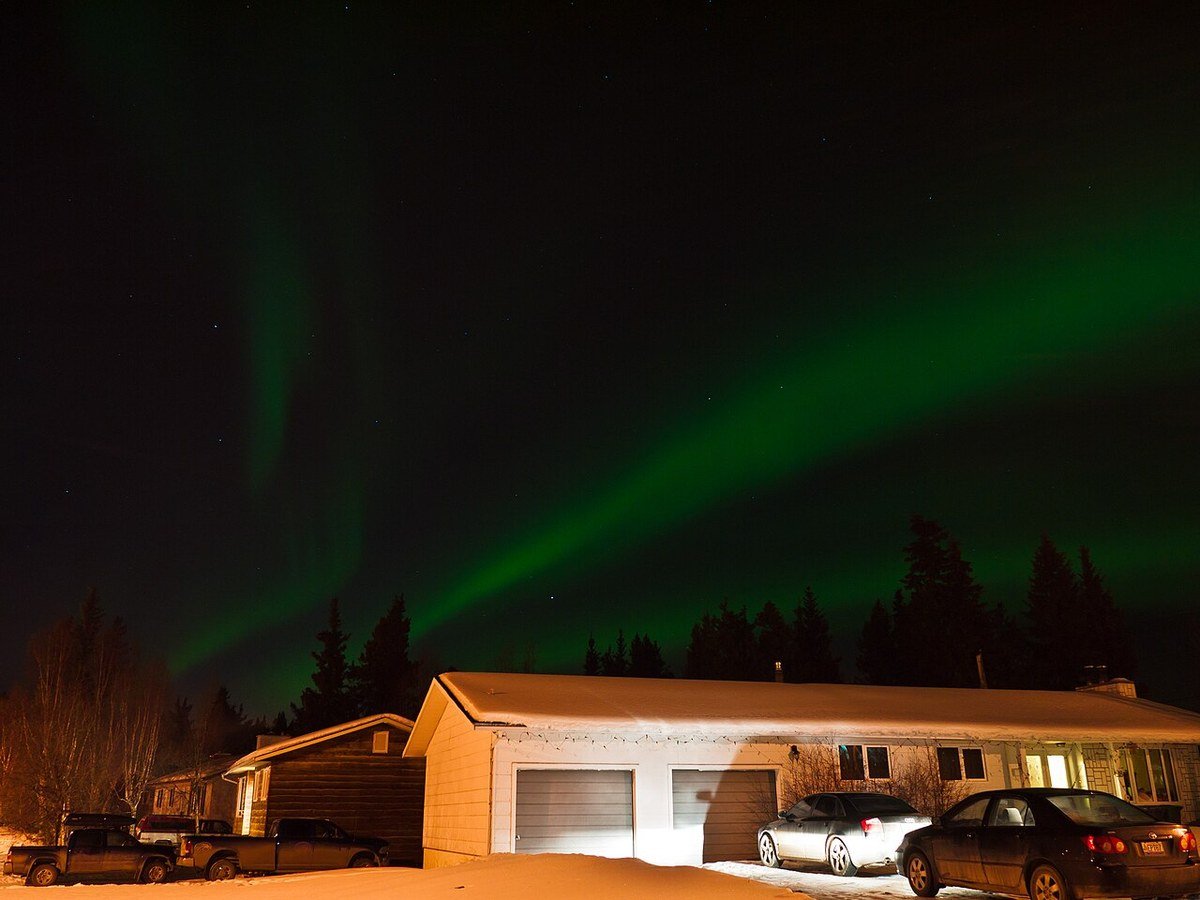
You can sometimes see the aurora from inside Whitehorse — the Riverdale photo below proves it, houses and parked cars and all — but do not build your trip on that. The real move is to drive 20–30 minutes out of town, up Fish Lake Road or out toward the hot springs road, where the sky goes properly dark. I went with a small guided tour on my first night, which I recommend for night one: the guide watches the forecasts and the cloud radar, drives you to wherever the sky is clearest, and keeps a warming shelter and hot drinks going while you wait. On the second and third nights I drove myself, and that worked too, once I knew the road and had a full tank, a charged phone, and a thermos.

What the aurora actually looks like in person is the thing nobody’s phone prepares you for. On camera it is neon green curtains. To the naked eye, on a moderate night, it starts as a pale grey-green band that you might mistake for cloud, and then it starts to move — slowly at first, then in waves, then, on a good night, in fast ripples with a hint of pink at the edges. My third night, standing at the Fish Lake lookout with my hands in my pockets and my camera on a tripod I could barely operate with gloves on, the whole sky went. I forgot about the cold for about twenty minutes, which, at −28°C, is the highest praise a sky can get.

Practical notes, learned the cold way. Dress warmer than you think for standing still: aurora watching is not hiking, you are mostly standing, and standing at −25°C in a city coat is a short experience. Wear the full kit — insulated boots, snow pants or an extra layer, a balaclava or a scarf for your face, and mittens over thin gloves so you can still work a camera. Bring a tripod; handheld aurora photos are mostly black rectangles with a green smear, and I have the black rectangles to prove it. Check the aurora forecast and the cloud forecast separately — a strong aurora under solid cloud is nothing. Allow roughly $100–200 per person for a guided aurora tour as a planning range, and check operators’ current prices before you book.
Do not drive the back roads at night on a low tank, a low phone battery, or summer tires. Fish Lake Road is a real Yukon road in winter: dark, icy in patches, and a long way from help if you slide off. I drove it in daylight first so I knew the turns, kept the tank above half, and told my hotel where I was going. That is not paranoia up here; it is just how people drive. If you are not confident on winter roads at night, take a guided tour and let someone else drive.
Dog sledding: the morning the dogs run the show
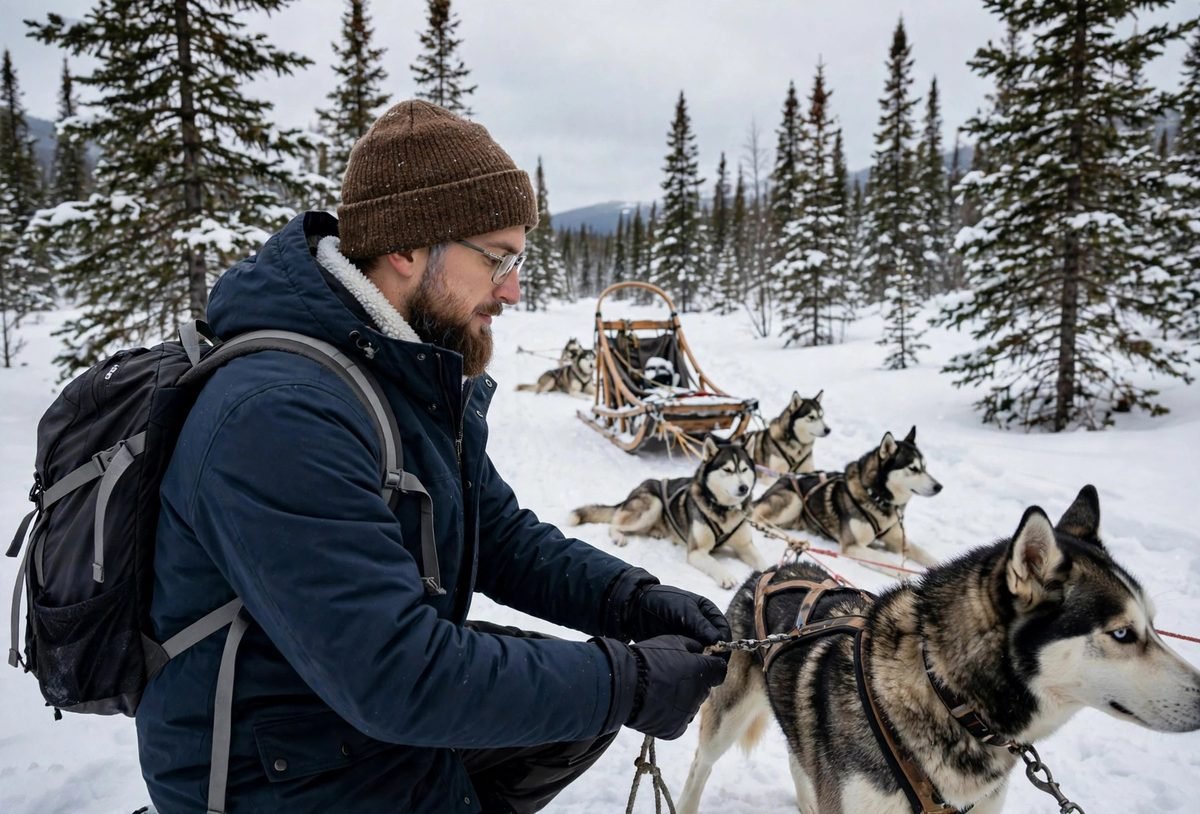
If the aurora is Whitehorse’s night, dog sledding is its morning — and it is the activity I would pick if you only do one paid thing. The kennels along Fish Lake Road and around town run half-day trips where you ride in the sled while a musher drives, or, on some trips, you learn to drive your own team with the musher riding along. I did the ride-along version, and I will be honest about what surprised me: the noise. Before the run, the dogs are barking, lunging, and desperate to go, in the way that only a team of huskies that loves its job can be. The second the sled starts moving, they go silent. All you hear is the runners on the snow and the musher’s quiet commands, and the forest sliding past at a speed that feels faster than it is because you are sitting about six inches off the ground.

Dog sledding is also the best way to understand why Whitehorse takes its dogs seriously. The Yukon Quest, the 1,000-mile race between Whitehorse and Fairbanks, is part of the town’s identity. On a tour, the musher will introduce you to the team by name, explain who leads and who would rather be anywhere else, and let you meet the dogs afterwards — which is half the experience, because a husky that has just run ten kilometres still wants a fuss. Allow roughly $200–350 per person for a half-day dog-sled trip as a planning range, and book ahead: the good kennels are small, the groups are small, and winter weekends fill up. Check each operator’s current offering before you book — some trips are ride-only, some are drive-your-own, and the difference matters.
Ask your musher about the dogs, not about the race times. I made the mistake of opening with race questions and got polite short answers; when I asked about one shy dog at the back of the team, I got a ten-minute story about her, and then stories about all of them. Mushers love people who notice the dogs as individuals. Also: wear the snow pants they lend you even if you think you look silly. Sitting in a sled throws up a surprising amount of snow, and your jeans will find out before you do.
Eclipse Nordic Hot Springs: the warm reward
After a night at −28°C and a morning on a sled, the hot springs are not a luxury — they feel like a medical necessity. Eclipse Nordic Hot Springs, on Takhini Hot Springs Road about 25 minutes from downtown, is the successor to the long-running Takhini Hot Springs, rebuilt with a set of outdoor pools at different temperatures, a cold plunge, and a nordic-style spa area. I double-checked the current pools and passes on the official Eclipse Nordic Hot Springs site before writing this, and you should do the same, because pool temperatures, session lengths and pass types are exactly the details that change.
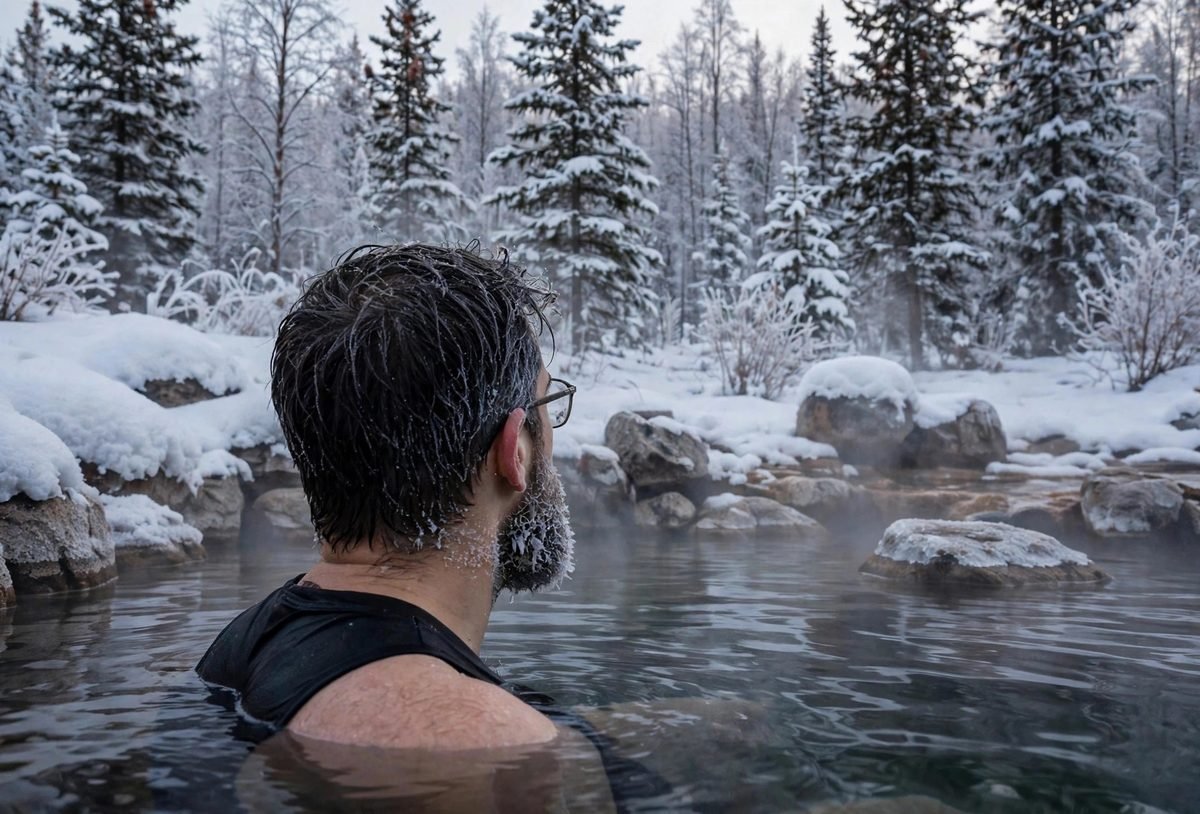
The experience itself is gloriously simple: you walk out of the change rooms into cold air in a swimsuit — which takes about ten seconds of courage — and sink into water that is somewhere in the high 30s Celsius while the air is somewhere in the minus 20s, and steam rises off the pool in thick clouds. My hair froze. Not metaphorically: the wet ends of my hair went stiff and crunchy, and I sat there grinning like an idiot while other soakers did the same thing, because everyone in a Yukon hot spring in January looks like that and nobody cares. Go in the late afternoon if you can, so you soak while the light goes and the steam catches the last of it, and stay for the stars if the sky is clear — the pools are far enough out of town that the sky is properly dark, and more than one person has watched the aurora from a hot pool. That is the Whitehorse trifecta in one evening: warm water, cold air, green sky.
One honest note, because this guide does not use a photo it cannot verify: I could not find a freely licensed photo of the Eclipse pools themselves that I could confirm was actually the pools, so this section has no photo rather than a wrong one. The pools are real, the steam is real, and the frozen-hair effect is real — you will just have to see them yourself. Allow roughly $25–45 per person for a soak as a planning range, plus the drive or a shuttle if you are not driving, and bring a towel, a warm hat for the walk back inside, and a bag for wet things that you do not mind getting cold.
Pair the hot springs with the wildlife preserve on the same outing — they are minutes apart on the same road, and the preserve’s guided bus tour in winter is the warm way to see animals that are built for this weather. Do the preserve first, in the daylight, and the pools second, as the light goes. It is the best half-day pairing in this guide, and it saves you a second drive out the same road.
Miles Canyon and the frozen river
Miles Canyon is the walk I would do on every Whitehorse winter trip, and it is the one that most surprised me. The canyon is a short basalt gorge on the Yukon River just south of town, where the river narrows and the water once ran so fast that sternwheelers had to be winched through. In winter the river is a different animal: the water slows under ice, the cliffs hold snow, and the suspension bridge that crosses the canyon sits quiet in a way that summer visitors never see. I walked it on a bright midday when it was about −18°C, and the whole place was empty except for a raven doing slow circles overhead and a couple of locals out with a dog that was clearly having a better day than anyone.

The walk itself is easy and short: park at the canyon, cross the bridge, and follow the trail along the rim before turning back. In winter, wear traction — the bridge deck and the trail ice up, and the canyon rim is not the place to test your balance. I wore microspikes over my boots, which felt like overkill until the first icy board on the bridge. The black-and-white photo below is the canyon in winter proper: snow on the banks, dark water, and the forest going on forever.

Winter days in town: the sternwheeler, the museums, and the riverfront
Whitehorse in winter is a small city, and that is a compliment: you can walk the downtown, see the big sights, and still be back for a long lunch. Start on the riverfront with the SS Klondike. She is a restored sternwheeler, a Parks Canada national historic site, sitting on the banks of the Yukon River where the sternwheelers once ruled the river trade. In winter she sits in the snow — the ice-fog photo below was taken at −26°C — and the grounds are a walk in themselves, with the river, the mountains, and the ship’s white hull against all of it. I double-checked the ship’s Parks Canada page before writing this; check the official Parks Canada SS Klondike page for current winter access and tour seasons before you go, because interior tours are a summer-season thing and winter visits are mostly about the grounds and the photographs.
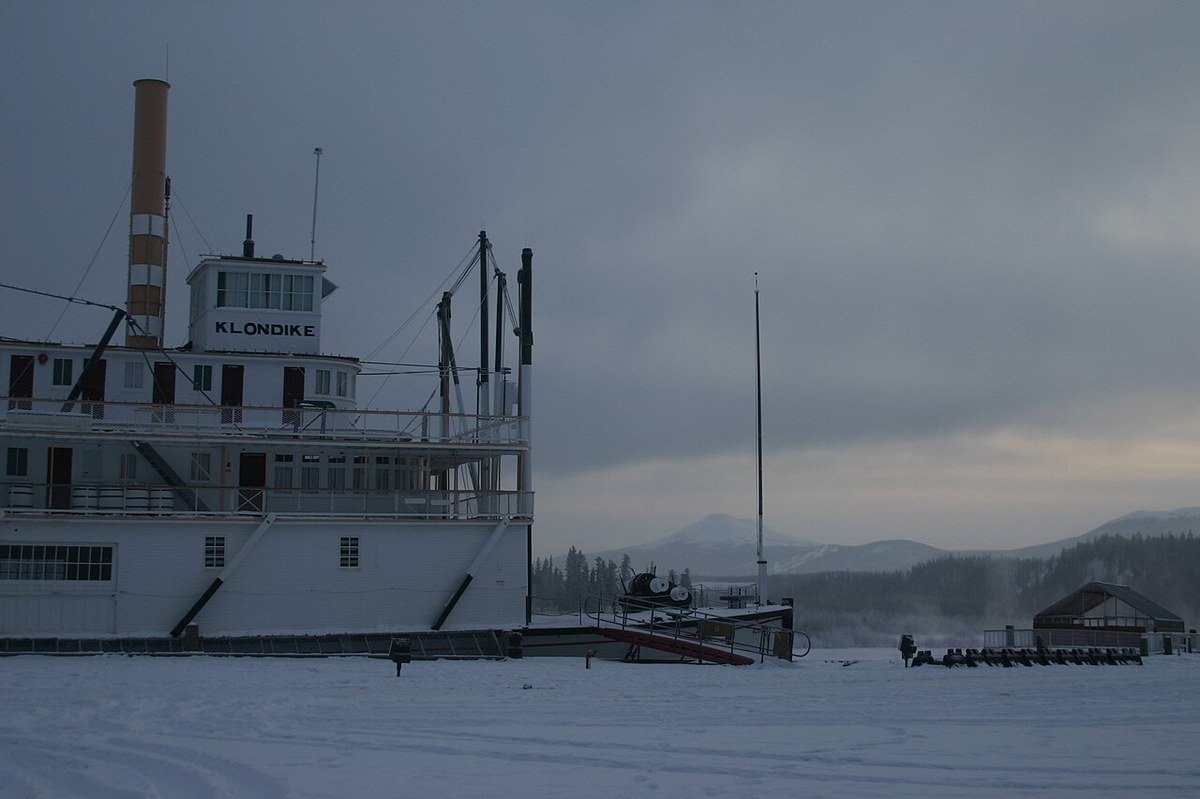

From the riverfront, walk up to Front Street and the MacBride Museum of Yukon History, which covers the Gold Rush, the sternwheeler era, and the people who built the territory. I went in on my coldest afternoon, mostly to warm up, and stayed for two hours because the Gold Rush exhibits make you understand why people came north — and why some never left. Check the official MacBride Museum site for winter hours, which are shorter than summer hours. A few minutes along the riverfront is the Kwanlin Dün Cultural Centre, celebrating the culture of the Kwanlin Dün First Nation, whose traditional territory includes Whitehorse. Check the centre’s official site for current exhibitions and hours. Together, the ship, the museum and the cultural centre give you the town’s story in half a day.
Yukon Wildlife Preserve: animals that actually like this weather
The Yukon Wildlife Preserve, a few minutes from the hot springs on Takhini Hot Springs Road, is the daytime stop that makes the most sense in winter, because its animals — moose, caribou, muskoxen, Dall sheep, mountain goats, lynx — are not enduring the cold. They are built for it. The preserve holds northern animals in large natural habitats, and in winter the guided bus tour is the way to see them: you stay warm, the guide knows where everyone is bedded down, and the animals show up against the snow in a way that summer visitors, squinting through green brush, never get. I double-checked the tours on the official Yukon Wildlife Preserve site before writing this; book the bus tour rather than planning to walk the whole loop in deep cold, unless you are dressed for a long winter walk and you mean it.

My preserve morning was the quietest hour of the trip in the best way. A moose stood in the trees a long way off, unbothered. A muskox stood in the snow looking like a piece of the Ice Age that had forgotten to leave. And a lynx, which the guide found for us with great patience, stared at the bus for exactly three seconds before deciding we were not interesting. Allow roughly $40–80 per person for the preserve with the bus tour as a planning range, and go in the morning, when the animals are most active and the light is at its best.
Do not try to walk the full preserve loop in −25°C because it looked short on the map. The loop is several kilometres, the wind on the open ground is real, and there is no café halfway round. Take the bus tour in winter, or walk only the first stretch and turn back. The same rule applies to Miles Canyon and the riverfront trails: short, bright, midday walks, not heroic winter hikes, unless you are properly equipped and someone knows where you are.
Getting there and getting around
Whitehorse is not a drive-up destination for most visitors — it is a flight, and that is part of the adventure. Erik Nielsen Whitehorse International Airport has year-round flights from Vancouver, Calgary and Edmonton, with additional seasonal connections, and the airport is about ten minutes from downtown. Check current routes for your dates, because northern schedules change by season. From the airport, a taxi or a rental car gets you downtown in minutes; there is no big-city transit system to learn, because Whitehorse is not a big city.
For getting around, this is the one guide in this series where I say it plainly: rent a car. The aurora spots, the dog kennels, the hot springs and the preserve are all out of town on roads that buses do not serve well in winter, and a car turns a trip of expensive tours into a trip where you can chase clear skies yourself. Get winter tires — they are not optional equipment up here, they are the difference between a trip and an incident — keep the tank above half, carry a phone charger, water, and a blanket in the boot, and drive the night roads in daylight first so you know them. If you do not want to drive at night at all, that is a perfectly good decision: take guided aurora tours, take the preserve bus tour, and use taxis in town. The trip still works; it just costs more in tours and less in rental.
For sleeping, stay downtown or in Riverdale if you can: downtown puts you on Main Street near the restaurants and the riverfront, and Riverdale, across the river, is quieter and darker at night, which some aurora watchers prefer. Expect roughly $150–250 a night for a mid-range downtown room in winter as a planning range. Food runs roughly $20–35 per person for a casual lunch, $35–60 for a sit-down dinner — northern prices, honestly, because everything is flown or trucked in. See the Canada trip cost guide for the country-wide picture, and our Canada in winter guide for how the Yukon fits into a national winter trip.
What a 4-day Whitehorse winter trip costs
Here is the honest math, per person, for four days based downtown. Every figure is an approximate planning range for 2026–27, not a quoted rate. Lodging assumes two people sharing a room, so the nightly room price is split in half. The calculator below covers food, sights, local transport and extras; lodging and the big-ticket dog-sled day are in the table.
| Expense (per person, 4 days) | Budget | Mid-range | Luxury |
|---|---|---|---|
| Lodging, 4 nights (shared room) | $240–400 | $480–760 | $1,200–1,800 |
| Activities: dog sled, hot springs, preserve, museums | $120–200 | $250–450 | $400–650 |
| Food, transport & extras (calculator, 4 days) | $600 | $960 | $1,680 |
| Estimated 4-day total, per person | $960–1,200 | $1,690–2,170 | $3,280–4,130 |
The table tells the real story: Whitehorse winter is not a cheap trip, because the flight, the car, and the dog-sled day do the damage, but the town itself gives you a lot for the price of dressing warmly — the canyon walk, the riverfront, the SS Klondike grounds, and the sky, which is free every clear night. The levers are the flight (book early, fly midweek if you can) and the tours (one guided aurora night plus self-driving the rest, one dog-sled day, not two). Use the calculator below for the day-to-day part of the budget: food, sights, local transport and treats. It does not include lodging, which is in the table above. Pick your style, set your days, and it does the rest.
Budget calculator
Per person, in Canadian dollars. Excludes accommodation.
Budget ≈ $150/day · Mid-range ≈ $240/day · Luxury ≈ $420/day. Add accommodation from the table above. Prices are planning ranges for 2026–27 — check official sites for your dates.
A 4-day Whitehorse winter itinerary that actually works
Day one: arrive, pick up the car, settle downtown, and walk the riverfront to the SS Klondike in the short afternoon light. Dinner downtown, early night, and a first aurora look — guided tour if you booked one, or a short drive up Fish Lake Road if the sky is clear and you are confident on the road. Do not try to fit a dog-sled trip into arrival day. The dogs will still be there tomorrow, and you will be jet-lagged and cold in a way that makes everything harder.
Day two: the dog-sled morning, out on Fish Lake Road, followed by a warm lunch back in town and an afternoon at the MacBride Museum and the Kwanlin Dün Cultural Centre. Evening aurora watch number two, self-driven if the forecast is good. Day two is the big outdoor day, and it should feel like one.
Day three: the Takhini Hot Springs Road pairing — Yukon Wildlife Preserve by bus tour in the morning light, Eclipse Nordic Hot Springs in the late afternoon as the light goes, and stars, maybe aurora, from the pools if the sky cooperates. This is the day people remember most, in my experience, because it is the day the cold stops being something you endure and starts being something you enjoy.
Day four: Miles Canyon in the bright middle of the day, a slow last lunch downtown, and a final look at the riverfront before you fly out. If the weather turns properly nasty, swap the canyon for a second museum morning and a long lunch — the trip still works. That is the point of a small city with a big sky: the backup plan is also a good plan.
FAQs about Whitehorse in winter
How cold is Whitehorse in winter, really?
January averages a daytime high around −13°C and a nighttime low around −19°C, with cold snaps below −40°C possible. Whitehorse is dry — often called Canada’s driest city — so the cold is a dry cold, and the town is built for it. Dress for −30°C even if the forecast says −15°C: insulated boots, snow pants or an extra layer, mittens, and something to cover your face for standing outside at night.
When is the best time to see the northern lights in Whitehorse?
The aurora season runs roughly from mid-August to mid-April, with the darkest, longest nights from December to March giving you the best odds. Whitehorse sits under the auroral oval and its dry air means clearer skies than many northern towns. Give yourself at least three nights — the aurora is weather, not a scheduled show — and check the cloud forecast as well as the aurora forecast. Our month-by-month northern lights guide covers the season in detail.
Do I need a car in Whitehorse in winter?
You can do the town without one, but a car makes the trip. The aurora viewpoints, the dog kennels, the hot springs and the wildlife preserve are all out of town on roads that winter buses do not serve well. If you rent, get winter tires, keep the tank above half, and drive the night roads in daylight first. If you would rather not drive at night, take guided aurora tours and the preserve bus tour instead — the trip still works, it just costs more in tours.
Is Takhini Hot Springs now called Eclipse Nordic Hot Springs?
Yes. The long-running Takhini Hot Springs on Takhini Hot Springs Road has been rebuilt and rebranded as Eclipse Nordic Hot Springs, with outdoor pools at different temperatures, a cold plunge, and a nordic-style spa area. It is the same road, the same hot water, and about 25 minutes from downtown. Check the official Eclipse site for current pools, sessions and passes before you go.
How many days do I need in Whitehorse in winter?
Four days is the sweet spot used in this guide: it gives you two or three aurora nights, one dog-sled morning, the hot-springs-and-preserve pairing, and the town sights without rushing. Three nights is the minimum honest bet for the aurora. With only two days, pick the aurora plus either the dogs or the hot springs, and save the rest for next time — Whitehorse rewards a return trip more than a rushed one.
What should I pack for Whitehorse in winter?
Pack for standing still at −25°C, not just for walking at −10°C: insulated winter boots with grip, snow pants or a warm second layer under trousers, a proper parka, mittens over thin gloves, and a balaclava or scarf for your face. Add microspikes or traction aids for icy trails and bridge decks, a tripod for aurora photos, and a swimsuit, towel and warm hat for the hot springs. Our Canada winter packing list covers the full kit.
Keep exploring
If Whitehorse winter has you planning the next leg, start with our where to see the northern lights in Canada guide for how the Yukon compares with Yellowknife and Churchill, our Canada in winter guide for the national picture, our Canada trip cost guide for the full daily budget, and our winter packing list before you buy anything new. Pack for −30°C, keep the aurora nights flexible, and leave room in the plan for a long soak and a longer dinner. Whitehorse rewards the traveller who slows down. You have got this.