
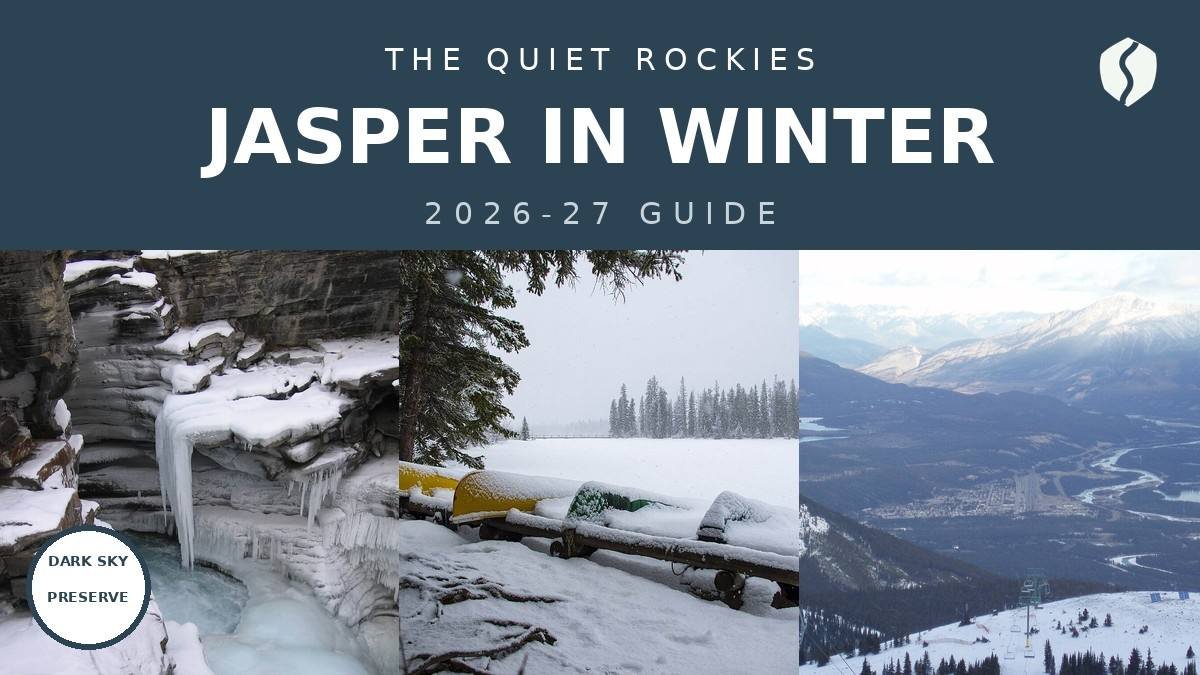
- ✓ Jasper in winter is the quiet Rockies: far fewer visitors than Banff, real cold, long nights, and a town small enough to walk end to end — inside the world’s second-largest Dark-Sky Preserve.
- ✓ Two closures change the classic itinerary, so plan around them: Maligne Canyon is closed after the 2024 wildfire (icewalks now run at Pleckaitis Canyon instead), and Miette Hot Springs is closed all winter — do not drive to either expecting them to be open.
- ✓ All prices here are planning ranges, not quoted rates: lift tickets, icewalk tours and rooms change by date, so check the official sites linked below for your exact dates.
I stepped out of my hotel in Jasper on a January morning at minus twenty-two, and the first thing I noticed was not the cold. It was the quiet. My boots squeaked on snow that sounded like Styrofoam, my breath froze on my scarf in about thirty seconds, and the whole town seemed to be holding still under a sky the colour of a bruise just before sunrise. I had come from Banff the day before, where the sidewalks were busy and the parking lots were full, and the contrast hit me before I had even had coffee. Jasper in winter is not Banff with fewer people. It is a different kind of trip altogether: slower, darker, colder, and — if you like that sort of thing, and I do — much better for it.
What follows is the trip I actually did over three days: a ski day at Marmot Basin, a guided canyon icewalk, frozen lakes and waterfalls, a night spent looking up, and a lot of hot chocolate in between. Every price below is an approximate planning range in Canadian dollars for 2026–27. I double-checked the canyon closure and the hot-springs season on the official Tourism Jasper and Parks Canada pages before writing this, because Jasper changed after the July 2024 wildfire, and a lot of older guides — including some still ranking well in search — describe a Jasper that no longer exists in quite the same way. You should check the same pages for your dates, because closures here are about safety in fire-damaged forest, not about convenience, and they do not lift on a schedule you can guess.
The stops on the map
Six stops: the town itself, the ski hill, two lakes, a waterfall, and the lodge on Lac Beauvert. Tap any stop to jump the map straight to it. Pleckaitis Canyon, where the icewalks now run, is not pinned exactly — operators run it as a guided tour from the Maligne Valley, and I did not want to guess a trailhead coordinate for a place I reached on a guided trip.
Map data © OpenStreetMap contributors. Open the full map

Read this first: Maligne Canyon is closed — here is the icewalk that replaces it
This is the single most important thing in this guide, so I am putting it first and saying it plainly: Maligne Canyon is closed, and Maligne Canyon icewalks are not running. The canyon and its trails were damaged in the Jasper Wildfire Complex in July 2024, and Parks Canada has kept the area closed for public safety — the current closure order prohibits winter access to the canyon for recreational activity, from the First Bridge parking lot to the Fifth Bridge junction. Tourism Jasper states the same thing in plainer language: Maligne Canyon will remain closed for the season due to safety concerns following the 2024 wildfire, and it was closed for the winter of 2025/2026. Pursuit, which used to run the Maligne Canyon Icewalks, says the same on its own page: following damage from the 2024 wildfires, Maligne Canyon Icewalks remains closed.
Do not let an old blog post, a pre-2024 video, or a booking site that has not updated its copy send you to the Maligne Canyon trailhead. There is nothing to see there right now except a closure, and in fire-damaged forest the risk is real — falling trees and unstable ground are the reason for the closure, not a paperwork delay. I double-checked this against the Tourism Jasper Maligne Canyon page and the Parks Canada closure bulletin before writing this, and you should re-check both before you travel, because a reopening, if it comes, will be announced there first, not in this guide.
If a tour listing still sells you a “Maligne Canyon Icewalk” for winter 2026–27, stop and ask the operator, in writing, where the walk actually goes. The honest answer right now is Pleckaitis Canyon, in the Maligne Valley, and an operator that will not say that clearly is not one I would book with.
The good news is that the icewalk itself has not disappeared — it has moved. SunDog Tours and Jasper Hikes & Tours both offer guided icewalks at Pleckaitis Canyon, in an area of Jasper National Park unaffected by the recent wildfires. SunDog’s Maligne Valley & Pleckaitis Canyon Icewalk runs from Jasper townsite with round-trip transport, scenic stops in the Maligne Valley (including Medicine Lake, conditions permitting), and a guided walk along the frozen canyon floor, with tours listed for December 15, 2026 to March 31, 2027. Check the operator’s own page for your dates and for what is included — boots, ice cleats and helmets are typically supplied, which matters, because a frozen canyon floor is not a place for ordinary winter boots.
My own icewalk morning started the way these things should start: with a guide handing me cleats and telling me, kindly but firmly, to put them on properly and not to wander off the group’s line. The canyon was narrower and quieter than I had pictured from the old Maligne photos — ice curtains hanging off the rock, the creek frozen into shapes that looked poured rather than formed, and a silence that made all six of us whisper without quite knowing why. Our guide stopped at a frozen waterfall, pointed out where the water still moved underneath the ice, and said the thing I have remembered since: in a canyon, you walk where the guide walks, because the pretty ice is also the thin ice. That is the whole case for going guided here, and it is stronger now that the walk is in a canyon most visitors have never heard of. Book ahead, dress warmer than you think you need to, and bring a spare pair of gloves — mine got wet on a handrail of ice within the first twenty minutes, and I was grateful for the dry pair in my pocket for the rest of the morning.
One honest flag: I could not verify a public, exact trailhead coordinate for Pleckaitis Canyon in Nominatim, and I have not pinned it on the map above for that reason. Operators describe it as a Maligne Valley canyon reached on their guided tours, and that is how this guide presents it — a guided experience, not a self-drive pin. If you want to walk a canyon on your own in Jasper this winter, ask at the Jasper Information Centre first about what is open that week. Do not improvise a route into a closed area.
Marmot Basin: skiing without the lift lines
Marmot Basin is the reason skiers come to Jasper in winter, and the reason non-skiers should not write the hill off. It sits about 20 minutes from town, it runs one of the longest seasons in Canada — typically mid-November to early May — and its base elevation, 1,698 metres, is the highest of any Canadian ski area base. The hill lists more than 90 runs across its faces, and the honest summary from the resort’s own site is that it is built for all abilities, with a snow school and gentle learning slopes as well as advanced bowls and trees. I double-checked the season shape on the official Marmot Basin site before writing this; exact opening dates move with snow each year, so treat mid-November as the usual start, not a promise for your week.
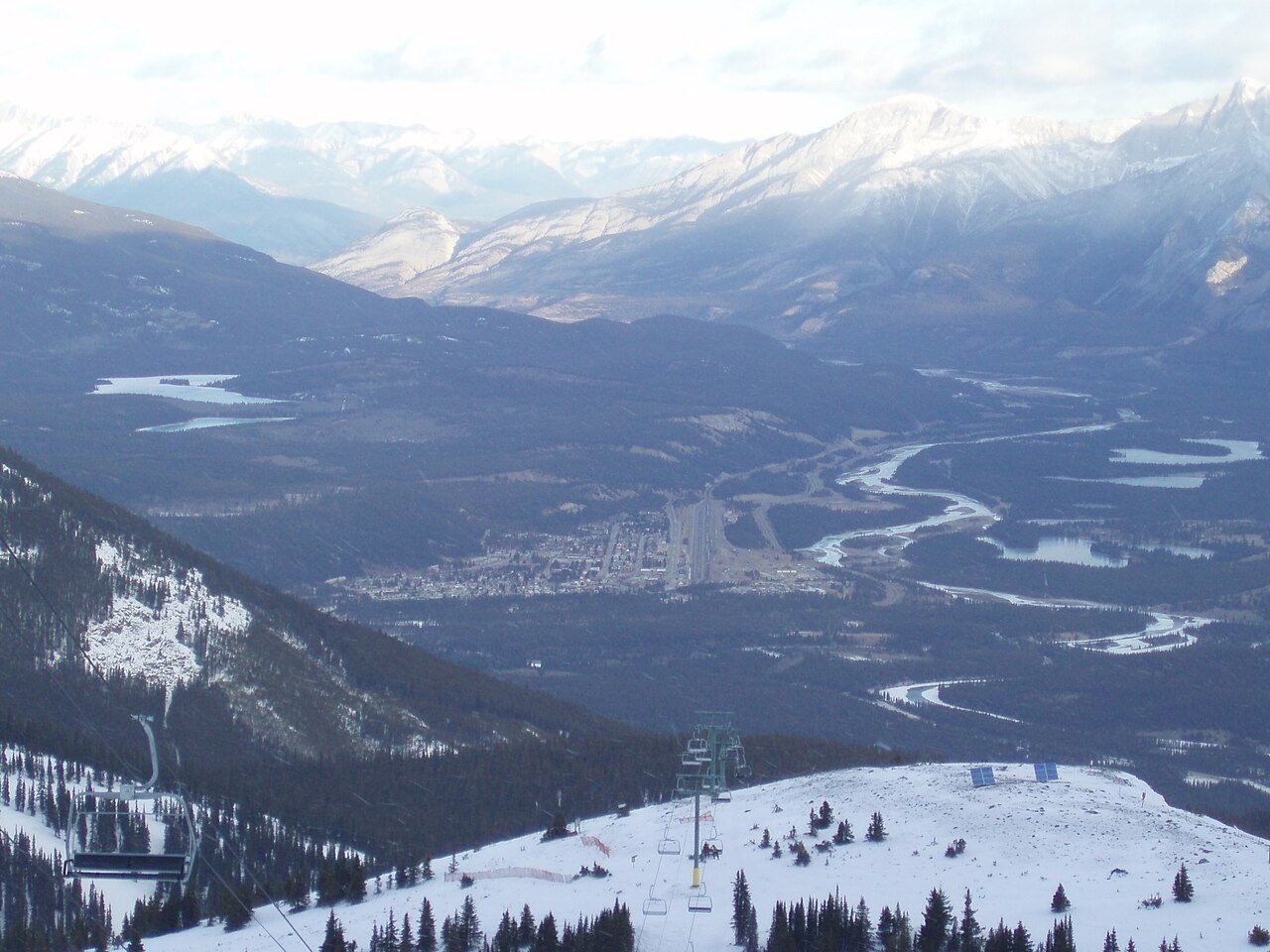
What I remember most from my Marmot day is not any one run. It is the lift lines, or rather the lack of them. I rode the Eagle Ridge quad on a weekday morning, looked down at the town far below in the valley, and realised I had spent more time that morning drinking coffee in the Caribou Chalet than waiting for a chair — which is the opposite of my usual ski-day arithmetic. The snow was cold and dry in the way interior Rockies snow is supposed to be, the groomers were wide and forgiving, and the whole hill felt uncrowded in a way that made me slow down instead of rushing to rack up vertical. If you are a strong skier, the upper mountain and the bowls are the draw. If you are learning, or returning after years away, the lower mountain is genuinely friendly, and the snow school is the right call rather than a reluctant friend’s advice.
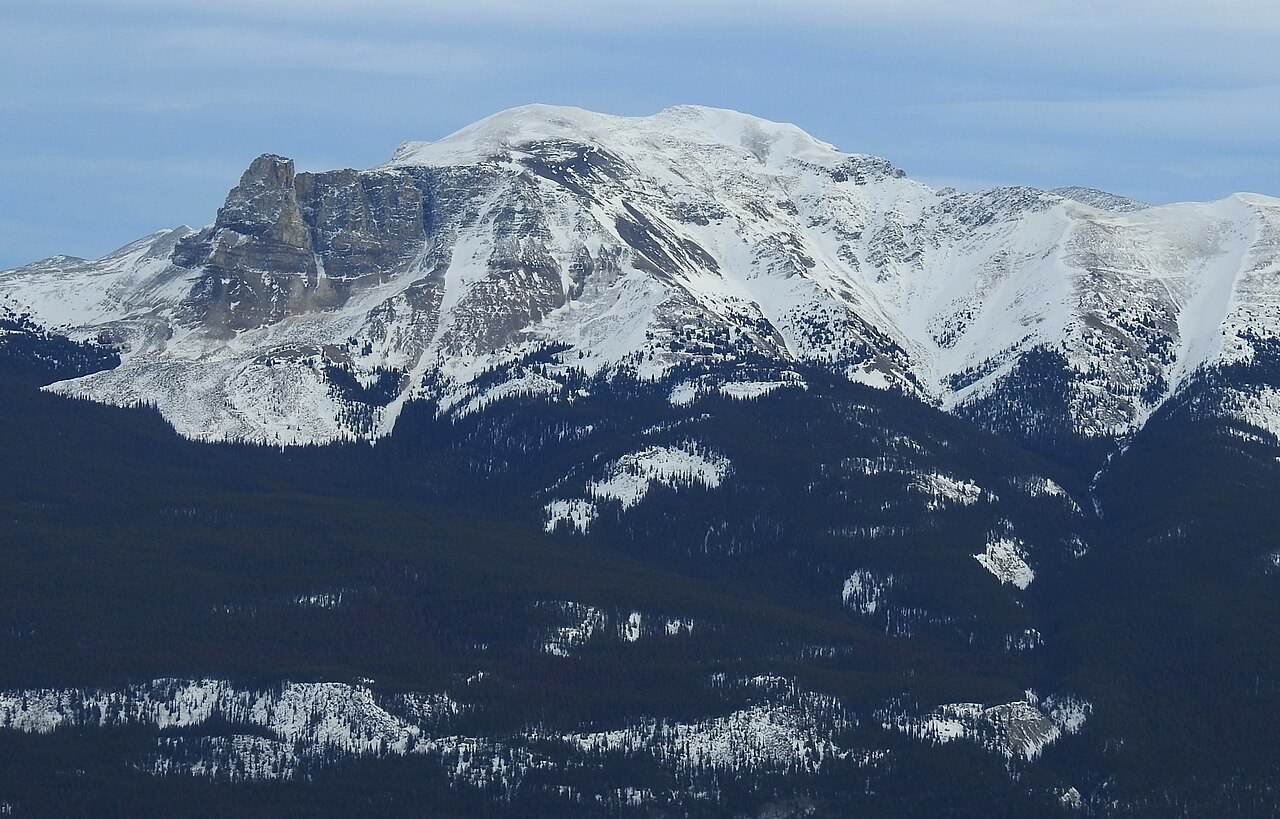
Budget-wise, treat Marmot as the big-ticket day of the trip: allow roughly $100–170 per person for a lift ticket plus rentals as a planning range, more for lessons, and check the resort’s own ticket page for your dates, because prices move by season and by how far ahead you buy. A shuttle typically runs from town to the hill in ski season, but I am deliberately not quoting its timetable here — check the resort site or ask your hotel, because the shuttle pattern changes by season. If you are driving yourself, the Marmot Road climb is a real winter mountain road: winter tires, daylight if you can manage it, and no shame in taking the shuttle instead. Our Banff in winter guide is the comparison point if you are choosing between the two ski towns — Banff has more hills and more crowds; Jasper has one hill and a lot more room.
Ski Marmot on a weekday if you can arrange it. Jasper’s quiet is real, but it is quietest Monday to Thursday, and the difference between a Tuesday and a Saturday on the hill is the difference between skiing and queueing. I skied a Tuesday, and I would plan around that again without hesitating.
Dark skies: the night is the attraction
Jasper National Park is the world’s second-largest Dark-Sky Preserve — designated by the Royal Astronomical Society of Canada in 2011, covering more than 11,000 square kilometres, behind only Wood Buffalo National Park — and in winter, that designation stops being a line on a brochure and becomes the evening plan. The nights are long (in January, you can be properly dark by 5 p.m.), the air is cold and usually clear after a cold snap, and the town sits inside the preserve, so you do not need to drive an hour to somewhere remote. You need to walk a few minutes away from the brightest streetlights and look up.
My dark-sky night did not go as planned, and that is why I remember it. I drove out to Pyramid Lake after dinner with a tripod, a thermos, and a phone at 80% battery, and within twenty minutes the phone was dead — cold kills phone batteries fast, and I had left the hand warmer in the hotel. I stood there annoyed for about a minute, and then, because there was nothing else to do, I just looked up. A faint green arc was hanging over the lake, not the dramatic curtain from the postcards, but unmistakably the aurora, moving slowly enough that I was not sure at first whether I was imagining it. I was not. The Milky Way was there too, in a way it never is over a city, and the lake ice was ticking and settling underneath me in the cold. I stayed an hour, went back to town, warmed up, and only then checked the aurora forecast I should have checked first. Lesson learned, and cheaply: check the forecast, bring a hand warmer for the phone, keep the phone in an inside pocket, and let your eyes adjust for twenty minutes before deciding the sky is empty.
Practical notes, honestly stated: the aurora is never guaranteed on any given night, and this guide does not promise it. Your best chances are a clear, moonless night, away from town lights — Pyramid Lake and Pyramid Island are the classic easy viewpoints minutes from town. Dress for standing still, not for walking: standing still at minus twenty is a different sport from hiking at minus twenty. Bring a headlamp with a red setting if you have one. If the sky is cloudy, do not force it — the next clear night is usually worth waiting for. This section has no photo, deliberately: I could not verify a Jasper-specific aurora photo on Wikimedia Commons, and a generic northern-lights stock shot under Jasper’s name would break the rule this site now lives by.
Walk out onto Pyramid Island by the wooden bridge on a clear night instead of driving somewhere far. It is five minutes from the Pyramid Lake parking area, it puts water and ice between you and the town lights, and it is where locals go when they do not want to make a production of it. I went because a hotel clerk told me to, and she was right.
Frozen lakes: Pyramid, Patricia, and the skating question
Pyramid Lake, about seven kilometres from town, is Jasper’s winter postcard, and it earns it. In winter the lake freezes, the summer canoes sit upturned and snow-covered on the shore, and Pyramid Mountain rises across the ice in a way that looks too neat to be real. I went at dawn on my second morning, mostly because I could not sleep through the quiet, and found the lake empty except for a skier far out on the ice and a raven doing loud raven business overhead. The loop around the lake and out to Pyramid Island is an easy snowshoe or winter walk, and the island’s wooden bridge is worth the short detour even in deep snow — just check the ice and trail conditions first, because a frozen lake is not automatically a safe lake.
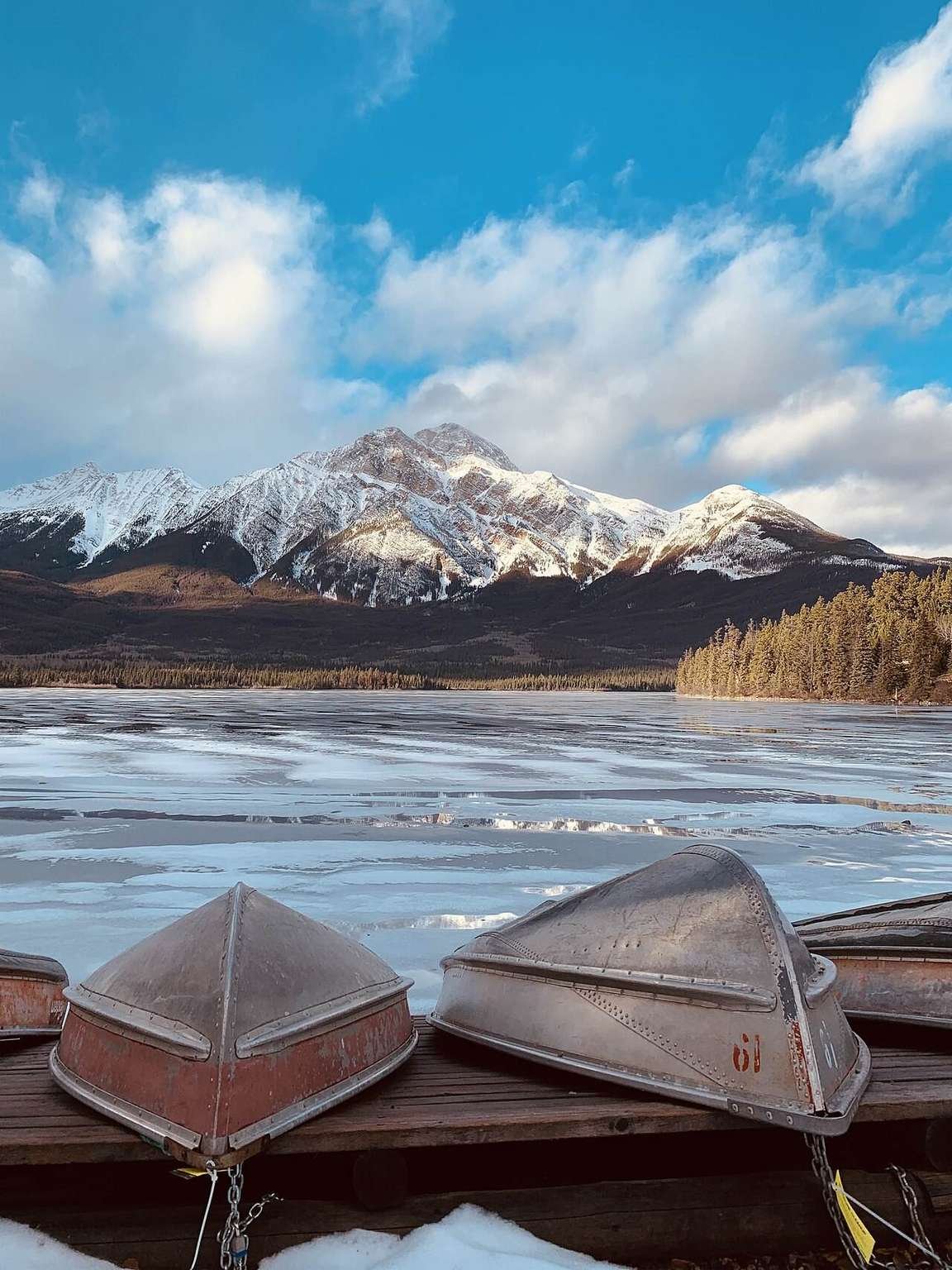
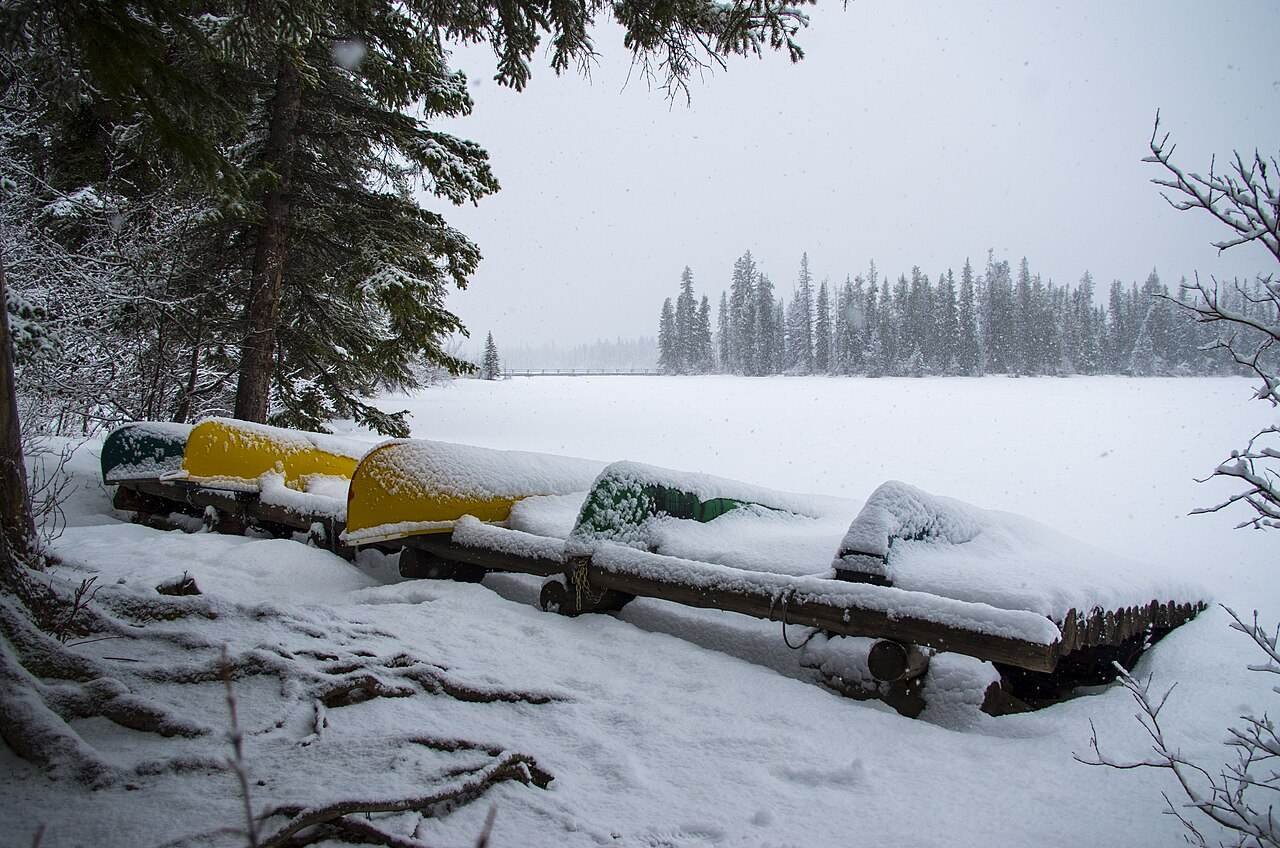
Patricia Lake, just before Pyramid on the same road, is the quieter sibling, and I liked it for exactly that reason. The view across Patricia Lake to Pyramid Mountain is one of the classic Jasper frames, and on a weekday winter morning you may well have it to yourself. The trail between the two lakes makes a natural snowshoe loop if you want a half-day out without driving anywhere new. I did the loop slowly, stopped far too often for photographs, and finished back at the car feeling like I had actually been somewhere, which is not always true of a short winter walk.
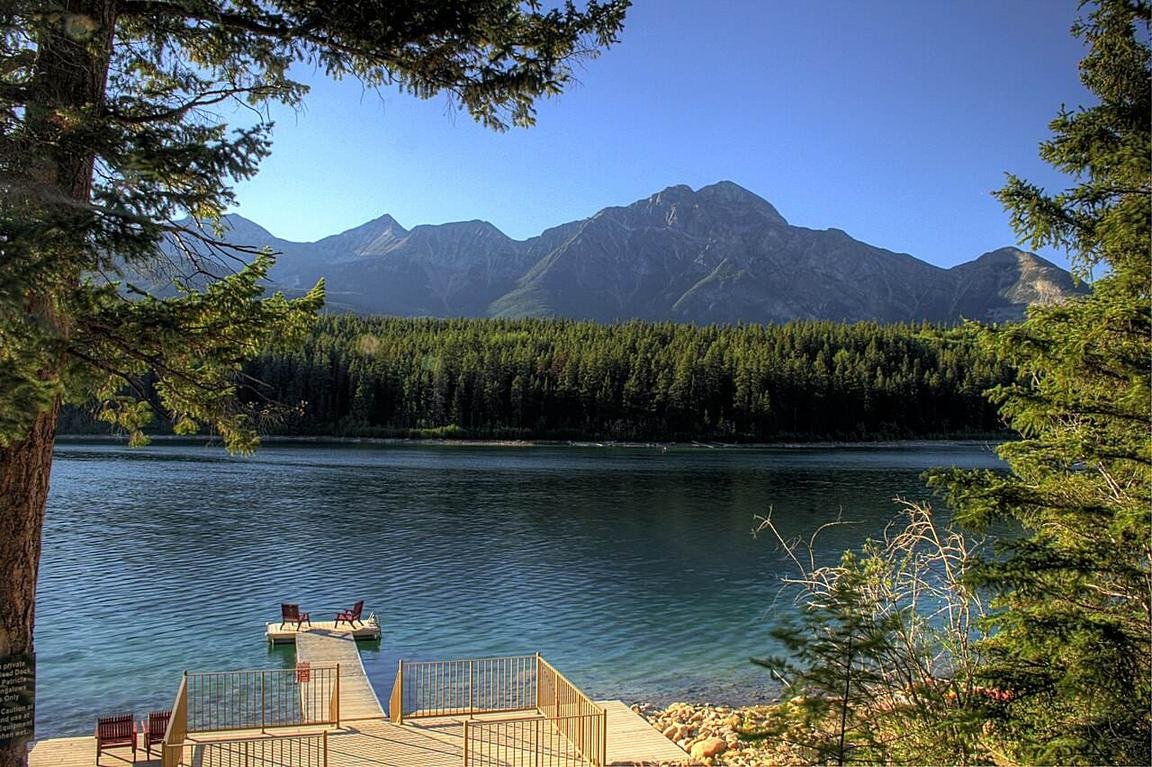
Skating on a natural lake is not like skating on a rink, and Jasper’s lakes do not come with a guarantee. Only skate where ice is clearly maintained or locally confirmed as safe for the day — ask at your hotel or the Information Centre, look for tracks and other skaters, and never skate alone on an unfamiliar lake at dusk. The maintained rink in town and the lodge rinks are the safe default; a wild lake is a decision, not a backdrop.
Athabasca Falls and the Icefields Parkway in winter
Athabasca Falls, about 30 kilometres south of town on the Icefields Parkway (Highway 93), is the winter drive that justifies itself. In summer the falls are loud and powerful; in winter they are half-frozen, with ice formations hanging off the rock walls and the river still moving, blue-green, underneath. The viewing platforms are a short walk from the parking area, but that short walk is icy in winter in a way that deserves respect — cleats or at least grippy boots, a hand on the rail, and no climbing over barriers for a photograph. I went on a bright, bitter morning, stood on the platform with my gloves off for exactly one photograph too many, and learned again that metal railings at minus twenty are not to be gripped bare-handed.

The Parkway itself in winter is a different proposition from the summer drive, and this guide is not going to dress it up. The full Icefields Parkway to Lake Louise is long, remote, and subject to winter closures, avalanche control, and weather that changes by valley. A day trip to Athabasca Falls and back is a sensible winter taste of it; the full drive to Banff in a single winter day, in bad weather, is not a plan I would make without checking road conditions twice and having a genuinely flexible schedule. Check Alberta 511 and Parks Canada road reports on the morning you go, carry a full tank, water, food, a blanket and a charged phone, and be ready to turn back. Our Icefields Parkway itinerary covers the full route in detail for the seasons when it makes sense, and our Lake Louise in winter guide is the southern end of that same drive.
Wildlife in winter: wonderful, and not tame
Winter is a good wildlife season in Jasper precisely because the animals come down to where people are. Elk graze the townsite lawns and golf course, bighorn sheep work the roadside slopes, and deer cross the roads at dusk with no particular interest in your schedule. I came around a bend on the Pyramid Lake road at dusk and found a herd of elk standing in the middle of it, completely unbothered, while I sat in the car for twenty minutes doing the only correct thing, which was nothing. A local later told me that is a normal Jasper evening, and after three days I believed him.

The caution here is not abstract. Elk are large, fast, and unpredictable, especially cows with calves and bulls in the autumn rut — and winter animals are stressed animals, burning energy they cannot spare. Parks Canada’s rules are simple and worth following exactly: keep your distance (at least 30 metres from large animals, more if they notice you), never approach or feed wildlife, keep dogs leashed and under control, and never get between an animal and its escape route. Photograph from the car or from a clear distance, and if an elk changes its behaviour because of you — head up, ears back, moving towards you — you are too close, and you should leave calmly. The same applies on the trails: make noise in brushy areas, carry bear spray in season as Parks Canada advises (bears are generally denning in deep winter, but the habit matters), and do not assume that a quiet animal is a tame one. Jasper’s wildlife is the reason many people come; giving it room is the price of seeing it well.
Drive the town and lake roads at dawn and dusk slowly, and expect animals on the road even where there is no sign. I saw more wildlife from the car at 7 a.m. than I did on any trail all trip, and the only close call I had was my own fault for going too fast around a blind bend on the way back from Pyramid Lake. Slow down. The animals were here first.
The hot springs trap: Miette is closed in winter
Here is the second closure that older guides get wrong, and it is an easy one to get wrong, because Miette Hot Springs is genuinely wonderful — in season. Miette is the hottest springs in the Canadian Rockies, with water flowing from the mountain at about 54°C and cooled to about 40°C in the pools, about 61 kilometres east of Jasper up the Fiddle Valley. It is also, firmly, a May-to-mid-October facility. Tourism Jasper’s own Miette page states the last day of the 2026 operating season as Monday, October 12, 2026, with closure from October 13, 2026 until reopening in May 2027. Parks Canada’s Miette page confirms the seasonal pattern in general terms: open daily, May to mid-October. The Miette Road is narrow, winding, and not maintained for winter access, and the pools are simply not open.
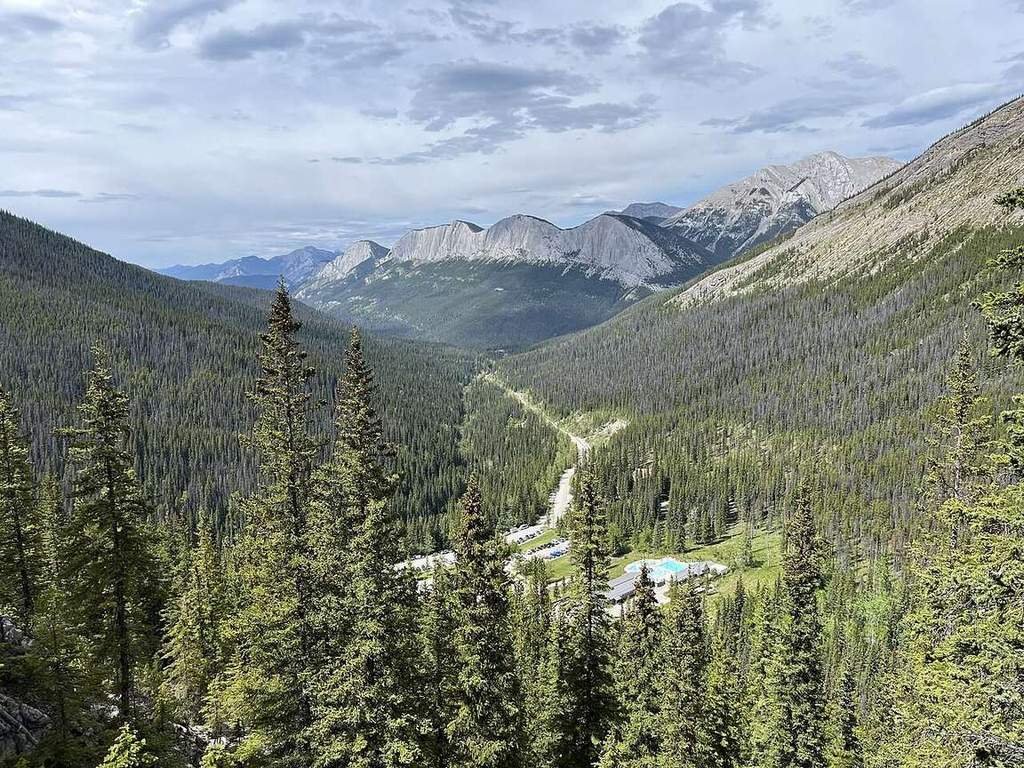
So do not drive to Miette in January expecting a soak, and do not put it on a winter itinerary as if it were open. The photograph above is included so you can see the place and plan a return trip in season — it is a summer view, and the caption says so, because a summer photograph under a winter heading would be exactly the kind of misleading illustration this site has stopped using. In winter, your soak is your hotel’s pool, hot tub, or spa, if it has one — check that when you book, rather than assuming a hot-springs day will fill the gap. If you are combining Jasper with Banff, note the contrast in our Banff in winter guide: Banff’s Upper Hot Springs run year-round, which is one genuine difference between the two towns in winter. Jasper’s winter answer to the cold is not a hot spring. It is a warm room, a hot drink, and a dark sky.
Where to stay and getting there
Stay in the townsite if this is your first winter trip. Everything in this guide except Athabasca Falls is within about ten minutes of Patricia Street, the town is walkable even in deep cold (in short bursts, with warm stops), and staying in town means you are not driving a dark mountain road home after stargazing. The Jasper Park Lodge, on Lac Beauvert a few minutes east of town, is the special-occasion alternative: cabins, a lakeside setting, and trails from the door, with winter rates that are usually kinder than summer ones. I stayed in town and walked to dinner every night, which is a small thing that made the trip feel like a trip rather than a series of drives. Our where to stay in Jasper guide covers neighbourhoods and hotel types in full; the short version for winter is this: town for first-timers, the lodge for a splurge, and anywhere with a pool or hot tub if a winter soak matters to you, given Miette’s closure.
Getting to Jasper in winter is the part to take most seriously. Most visitors drive from Edmonton (about four hours) or from Banff via the Icefields Parkway (about four hours in good conditions, longer in winter, and not a drive to rush). There is also train service to Jasper and bus connections, but schedules are thinner in winter, so check them for your dates rather than assuming a daily departure. If you drive — and most winter visitors do — winter tires are not a nice-to-have on these roads, they are the difference between a trip and an incident. Alberta requires winter tires on some mountain routes in season, and Jasper’s roads, with wildlife, ice, and sudden weather, are exactly where that rule earns its keep. Keep the tank full, check Alberta 511 before every out-of-town drive, and build a spare day into the plan if you can: Jasper rewards the traveller who is not forced to drive the Parkway in a storm because a flight leaves at noon.
For food, expect roughly $15–25 per person for a casual lunch and $25–45 for a sit-down dinner as planning ranges, and book dinner ahead on weekends — winter Jasper is quiet, but it is not empty. Many smaller places run reduced winter hours, so check hours on the day, not just on a website last updated in July.
What a 3-day Jasper winter trip costs
Here is the honest math, per person, for three days based in town. Every figure is an approximate planning range for 2026–27, not a quoted rate. Lodging assumes two people sharing a room, so the nightly room price is split in half. The calculator below covers food, sights, transport and extras; lodging and the big-ticket ski and icewalk days are in the table.
| Expense (per person, 3 days) | Budget | Mid-range | Luxury |
|---|---|---|---|
| Lodging, 3 nights (shared room) | $180–300 | $300–480 | $840–1,350 |
| Activities: Marmot day, Pleckaitis icewalk, rentals | $80–150 | $200–350 | $350–600 |
| Food, transport & extras (calculator, 3 days) | $330 | $570 | $990 |
| Estimated 3-day total, per person | $590–780 | $1,070–1,400 | $2,180–2,940 |
The table tells the real story: Jasper winter is not a cheap trip, because the ski day and the icewalk are both ticketed, but it is cheaper than Banff in winter for the same three days, mostly because lodging is kinder and nothing here charges a crowd premium. The levers are lodging (weekdays, and a room with a kitchen if you will actually cook) and the activity days (one ski day, not two, unless skiing is the point of the trip). Use the calculator below for the day-to-day part of the budget: food, sights, local transport and treats. It does not include lodging, which is in the table above. Pick your style, set your days, and it does the rest.
Budget calculator
Per person, in Canadian dollars. Excludes accommodation.
Budget ≈ $110/day · Mid-range ≈ $190/day · Luxury ≈ $330/day. Add accommodation from the table above. Prices are planning ranges for 2026–27 — check official sites for your dates.
A 3-day Jasper winter itinerary that actually works
Day one: arrive, settle in town, and walk Patricia Street in the late afternoon light. Dinner in town, and if the sky is clear, a first stargazing walk to Pyramid Lake after dark — no driving far, no production, just a look up. Do not try to fit a ski day into arrival day. The snow will still be there tomorrow, and the drive in deserves your full attention.
Day two: the icewalk in the morning, booked ahead, with transport included if you are not driving the Maligne Valley road yourself. Back in town for a late lunch and a warm afternoon, then Pyramid and Patricia lakes in the golden hour before dark, and a second stargazing attempt if the first night was cloudy. Day two is the quiet-outdoors day, and it should feel like one.
Day three: the Marmot Basin ski day, on the clearest forecast of your trip if you can arrange it, or Athabasca Falls and the Parkway taste if nobody skis. Back in town by late afternoon, a long dinner, and a last walk through the townsite after dark — Jasper at night, with the streetlights low and the sky overhead, is the memory you will actually take home. If the weather turns properly nasty, swap the outdoor day for a slow town day — a museum, a long lunch, a second café — and the trip still works. That is the point of a town where the backup plan is also a good plan.
FAQs about Jasper in winter
Is Maligne Canyon open in winter?
No. Maligne Canyon is closed after damage from the July 2024 Jasper wildfire, and the Parks Canada closure order prohibits winter recreational access to the canyon. Do not go to the trailhead expecting an icewalk. Guided icewalks now run at Pleckaitis Canyon in the Maligne Valley instead, offered by operators including SunDog Tours and Jasper Hikes & Tours — book with an operator that names Pleckaitis Canyon clearly, and re-check Tourism Jasper and Parks Canada before you travel in case the closure status changes.
Is Miette Hot Springs open in winter?
No. Miette Hot Springs is a May-to-mid-October facility; Tourism Jasper lists its 2026 season as ending October 12, 2026, with reopening in May 2027, and the Miette Road is not maintained for winter access. In winter, plan on your hotel’s pool, hot tub, or spa instead — and if a year-round hot spring is essential to your trip, Banff’s Upper Hot Springs, which run year-round, are the alternative.
Do I need a car in Jasper in winter?
The town itself is walkable, but a car is strongly recommended for a winter trip: Marmot Basin, Pyramid and Patricia lakes, and Athabasca Falls are all drives from town, and winter bus and shuttle options are thinner than in summer. If you drive, winter tires are essential, check Alberta 511 before every out-of-town drive, and keep the tank full. Guided tours (including the Pleckaitis icewalk, which typically includes transport) are the car-free way to cover the canyon day.
When is the best time to see the dark skies and northern lights in Jasper?
Winter is the best season for dark skies, because the nights are long and the air is often clear after a cold snap — January nights can be properly dark by 5 p.m. Jasper National Park is the world’s second-largest Dark-Sky Preserve, designated in 2011, covering more than 11,000 square kilometres. The aurora is never guaranteed on a given night: pick a clear, moonless night, get away from town lights (Pyramid Lake and Pyramid Island are the easy viewpoints), check an aurora forecast, dress for standing still, and give your eyes twenty minutes to adjust.
Is Marmot Basin good for beginners?
Yes. Marmot Basin lists more than 90 runs for all abilities, with a snow school and gentle learning slopes alongside advanced bowls and trees, and a season that typically runs mid-November to early May. Beginners should still book a lesson rather than learning from a friend, and check the resort’s own site for lift-ticket prices and shuttle details for your dates — this guide gives planning ranges only, not quoted rates.
Is Jasper safe for wildlife viewing in winter?
Yes, with distance and common sense. Elk, deer, and bighorn sheep are commonly seen in and around town in winter, and they are wild animals, not photo props. Keep at least 30 metres from large animals (more if they notice you), never approach or feed them, keep dogs leashed, and never get between an animal and its escape route. Drive slowly at dawn and dusk, when animals are most active on the roads, and expect them on the road even where there is no sign.
Keep exploring
If Jasper winter has you planning the next leg, start with our where to stay in Jasper guide for the full lodging picture, our Banff in winter guide for the busier, bigger southern neighbour, our Lake Louise in winter guide for the frozen lake at the other end of the Parkway, our Icefields Parkway itinerary for the full drive when the seasons allow it, and our Canada trip cost guide for the national picture. Pack warmer than you think, check the closure pages before you go, and leave room in the plan for a cloudy night and a slow morning. Jasper rewards the traveller who does. You have got this.