

Last updated: November 4, 2026
- ✓ Yellowknife sits directly under the auroral oval: the territory’s tourism office puts visible aurora at up to 240 nights a year here, and on a clear night even a low Kp reading is enough for green arcs overhead.
- ✓ Clouds are the enemy, not solar activity: book 4–5 nights so one or two cloudy nights can’t sink the trip, and check the cloud forecast before you check any aurora app.
- ✓ All prices here are planning ranges, not quoted rates: tour prices, hotel rates and flight fares move by date, so check the official sites linked below for your exact dates.
Here’s the deal with Yellowknife: I went for the northern lights and nearly missed them on night one because I didn’t know what I was looking at. It was minus 30, I was standing in a rented parka that made me look like a traffic cone, and the sky had this faint grey smudge over the trees. I thought it was cloud. My guide said, “That’s it. Wait.” Ten minutes later the smudge turned green,
then it rippled, then it filled half the sky. I’ve made this mistake so you don’t have to: in Yellowknife, the aurora often starts out
looking like nothing at all.
Yellowknife is the capital of the Northwest Territories, a fly-in city of about 20,000 people on the north shore of Great Slave Lake, at 62.45°N — directly beneath the auroral oval, the ring around the magnetic pole where the lights show up most. That position is the whole story. Most aurora destinations sit at the edge of the oval and need a solar storm to deliver. Yellowknife sits inside it. I double-checked the season dates and the 240-night figure on the official Spectacular NWT aurora page before writing this, and the national picture on Destination Canada’s Yellowknife aurora guide — both are linked below, and both agree on the shape of the season even if the exact night counts are estimates, not promises. Nobody can promise you the lights on a given night. Anyone who does is selling something.
Aurora watching means standing on a frozen lake for hours — our editor’s aurora pick, the Baffin Impact, is in our guide to the best winter boots for Canada.
For the coat, see which parkas we rate for standing outdoors in serious cold in our best winter jacket for Canada comparison.
The stops on the map
Eight stops: the airport, the town stops, the ice-road crossing to Dettah, and the Ingraham Trail corridor where the real viewing happens. Tap any stop to jump the map straight to it.
Map data © OpenStreetMap contributors. Open the full map
Why Yellowknife, and not somewhere easier
Fair question. Yellowknife is not easy to reach, it is not warm, and it is not cheap. It wins on one number and one fact. The number: up to 240 nights of visible aurora a year, according to Spectacular NWT, the territory’s official tourism organization. The fact: the city sits at 62.45°N, inside the auroral oval rather than at its edge. I double-checked both on the official Spectacular NWT aurora page before writing this, and Destination Canada’s month-by-month Yellowknife guide says the same thing in different words — a dry winter climate, far from an ocean coast, under the oval. That combination is why a three-night stay here has a realistic shot and a one-night stay is a lottery ticket.

Understand what that 240 number is, though, because it gets oversold. It counts nights when aurora is active above Yellowknife, not nights when you personally see it. Cloud cover, moonlight, and city light pollution all get a vote. The operators’ much-quoted “95% success over three nights” claims come from their own multi-night tour records in peak season, not from a measurement you can audit. My honest version: stay 4–5 nights, go outside town, and treat every clear night as the one that counts. That plan worked for me. It fails sometimes. That’s the deal with a natural phenomenon.
When to go: two seasons, very different trips
Yellowknife has two aurora seasons, and picking between them is the biggest decision in this guide. The winter season runs mid-November to early April. The fall season runs mid-August to late September. Between them — October to mid-November, and late April to mid-August — the odds drop off a cliff: October brings the year’s thickest cloud, and summer brings the midnight sun, which washes the sky out entirely. Our companion guide to the best time to see the northern lights in Canada covers the national picture, and our solar maximum guide explains why 2026–27 is still a strong window even though the cycle peaked in 2024.
Winter is the classic trip and the one I did. Nights are 15-plus hours long, the lake is frozen, the ice road is open, and the cold is the real thing: climate summaries put January at an average high near −21°C and an average low near −29°C, with a daily mean around −25°C. That is not “bring a warm jacket” cold. That is “rent the parka, wear the borrowed boots, and don’t touch metal with bare skin” cold. No joke — on my first night out, my phone died in about ten minutes in an outside pocket, and I lost the first display’s photos to a cold battery. Keep the phone inside your jacket, against your body, and only take it out to shoot.
Minus 30 is not a number to be brave about. Frostbite on exposed skin can start in minutes at these temperatures with wind. The tour operators all rent proper parkas and boots for a reason — take them up on it even if you own a good winter coat. Your city coat is not this coat. I know, because I wore mine on night one and spent half the night thinking about my knees instead of the sky.
Fall is the sleeper pick. Mid-August to late September gives you open water on Great Slave Lake, which means aurora reflections on calm nights — a shot winter can’t offer — plus daytime hiking, paddling, and temperatures you can actually enjoy. The trade: nights are shorter, so the viewing window is smaller, and the season is short. Destination Canada’s guide calls late February and March the best months for first-timers, and I agree with their reasoning: the equinox months get a measurable bump in geomagnetic activity, the nights are still long, and March is noticeably less brutal than January. If you can only go once, go in March, on a new-moon week, for 4–5 nights.

The viewing night: tour, teepee, or do it yourself
Most visitors do at least one guided night, and for a first trip I think that’s right. The standard format: a bus or van picks you up in town around 9 pm, drives 20–30 minutes out the Ingraham Trail away from the town lights, and drops you at a heated site — the best-known is Aurora Village, whose viewing site sits on the Ingraham Trail (its downtown office is a different address, so don’t navigate to the office at night). You wait in a heated teepee, someone watches the sky, and when the lights show, everyone piles outside. Tours usually run until 1–2 am. I double-checked Aurora Village’s location on the operator’s own site before writing this: Ingraham Trail, outside town, not downtown.

The teepee matters more than it sounds. A Yellowknife viewing night is mostly waiting, and waiting at minus 30 without shelter is a short activity. The heated teepee turns a four-hour night into something you can actually enjoy — hot drinks, a place to warm your hands, and a guide who can tell the difference between cloud and faint aurora, which, as night one taught me, is a real skill. Budget roughly $150–250 per person per tour night as a planning range; multi-night packages bring the per-night cost down, and some lodges bundle tours with rooms.
Doing it yourself is possible but only with a car, a dark-sky spot picked in daylight, and a cloud forecast you trust. The Ingraham Trail pullouts east of town are the classic DIY spots — drive out, kill the lights, wait. Do not do this alone on your first night, and do not drive the trail at night in a storm. The road is a real northern highway in winter: dark, icy, and a long way from help if you slide off. If you rent a car for the daytime trips in this guide, read our winter driving guide for tourists first — the tire and storm-protocol sections apply here in full.
Check the cloud forecast first and the Kp index second. Under the oval, Kp 2–3 on a clear, dark night is plenty for visible green arcs — the apps that make you wait for Kp 5 are written for people in Edmonton, not Yellowknife. And remember Kp is a three-hour average of past conditions, not a live reading: a display can peak and fade inside an hour while the number lags behind. Clear sky beats a high number every time.
Photographing the lights without ruining the night
Here’s the short version: bring a tripod, or don’t bother. A phone on a tripod with a long-exposure night mode can get a decent aurora shot in Yellowknife — the lights here are bright enough. A phone held in shaking, freezing hands cannot. If you have a real camera, the recipe is simple: manual focus set to infinity (tape the focus ring if you have to — autofocus hunts in the dark and loses), ISO 1600–3200, aperture wide open, 8–15 second exposures, and a remote shutter or two-second timer so you don’t shake the frame. Shoot RAW if your camera allows it; the green comes out cleaner in editing.

Two honest warnings from my own roll of failures. First, the aurora you see with your eyes is usually dimmer and greyer than the photo — cameras collect light over seconds and your eyes don’t, so don’t spend the whole display staring at your screen wondering why the sky looks “wrong.” It isn’t wrong. Second, batteries die fast in this cold. I carried two spares inside my jacket and still burned through one by midnight. Keep spares warm, keep the phone warm, and give yourself at least one display where you just watch. You’ll remember that one better than the photos anyway.
Daytime in Yellowknife: Old Town, the Rock, and the museum
Yellowknife days in winter are short — in December you get roughly five hours of proper daylight — so plan them like the scarce resource they are. Start in Old Town, the original gold-rush settlement on the point, where log cabins from the 1930s sit next to floatplane docks and houseboats frozen into Yellowknife Bay. I walked Ragged Ass Road — yes, that’s the real street name, and yes, everyone photographs the sign — and spent a happy hour just looking at how people build a life on Canadian Shield rock: cabins jacked up on cribbing, boats hauled out for winter, and a general sense that the town grew up sideways rather than planned.

Climb the hill to the Bush Pilots Monument for the view that explains the town: Great Slave Lake on one side, the rock and the bay on the other, and floatplanes below in summer. The monument itself is a plane on a pedestal, honouring the bush pilots who opened the North — and the photo below is the real thing, not a stand-in. It’s a short, steep walk from Old Town, and in winter the steps ice up, so take it slow. I’ve made this mistake so you don’t have to: I went up in smooth-soled boots and came down a lot faster than I went up.

For the indoor hours, the Prince of Wales Northern Heritage Centre is the territory’s museum and archives, sitting above Frame Lake on the edge of downtown. It’s the place that turns Yellowknife from “aurora stopover” into a real place with a history: Dene and Inuvialuit culture, the gold rush, the aviation era, and the diamond mines that built the modern town. Admission is free (check the centre’s site for current hours before you go — winter hours are shorter). The Frame Lake Trail loop below it is the in-town walk if you want daylight and fresh air without a car: flat, lakeside, and about an hour at a stroll. Don’t count on it for aurora viewing, though — town lights wash out the faint stuff. The trail is for daytime.
The houseboat bay in Old Town is worth a slow walk even in deep winter, when the boats are frozen in and the bay is a working yard rather than a postcard. Go in the late afternoon when the light goes sideways across the ice — it’s the best free hour in town, and almost nobody doing the aurora-tour circuit bothers with it. I nearly didn’t either, and it ended up being my favourite daylight memory of the trip.

The Dettah ice road: driving on the lake
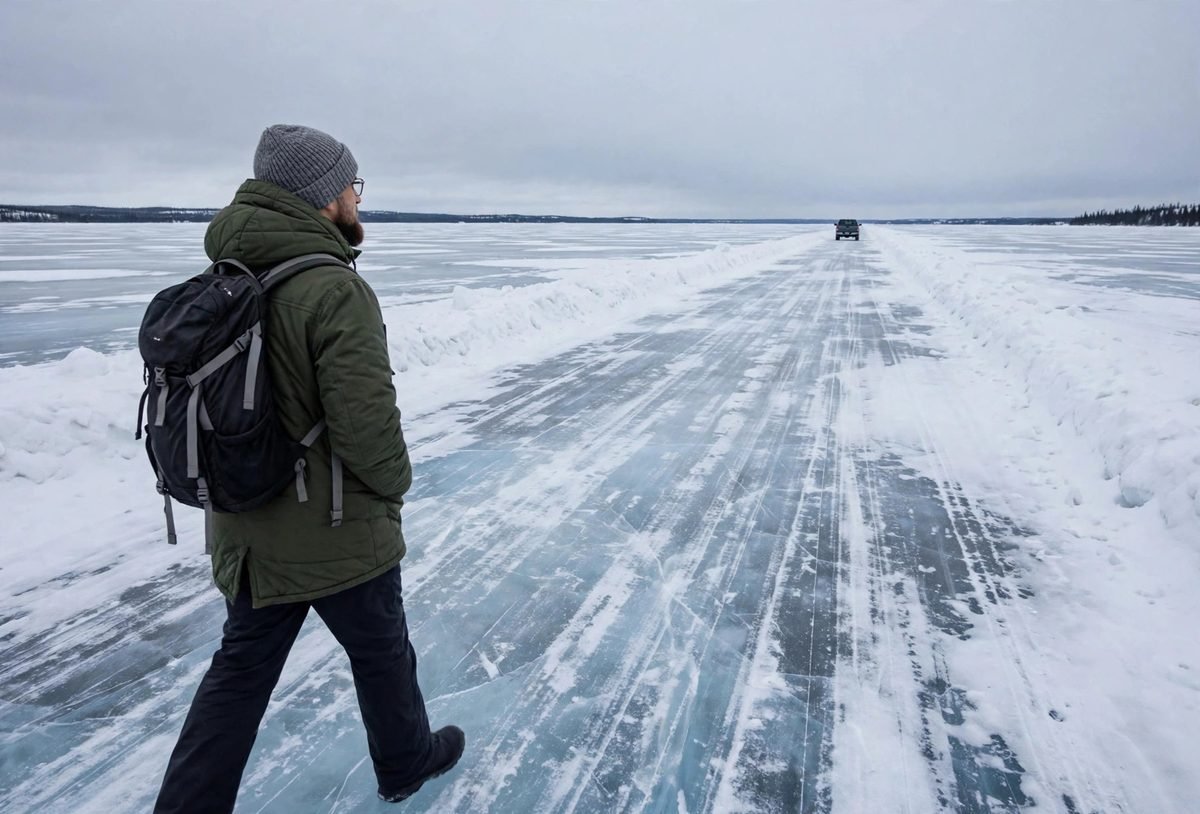
The winter road to Dettah is the daytime experience I tell people about first. Dettah is a Yellowknives Dene community across Yellowknife Bay, about 27 km by summer road and roughly 6.5 km straight across the ice in winter. When the ice is thick enough — usually from December or January into April — the city opens the ice road, and the drive takes about ten minutes. Ten minutes of driving on a frozen lake, with the town skyline shrinking behind you and the ice stretching out flat and white in every direction. Worth the detour doesn’t cover it.

Rules, because this is a real road with real consequences: obey the posted speed limit (it’s low, usually 30 km/h, and it’s enforced), keep your distance from the vehicle ahead, and never stop on the ice for photos — pull off only where signed. The ice road closes and reopens with conditions, and it closes for the season in spring when the ice weakens, so check the city’s current status before you plan a day around it. And a note on respect: Dettah is a community, not a viewpoint. Drive through quietly, don’t photograph people’s homes, and if you stop, stop at the public areas. The road is the experience; the community is not the attraction.
Cameron Falls: the frozen waterfall day trip
The Ingraham Trail (Highway 4) runs east from town past the aurora sites and into the real wilderness, and the Cameron Falls Trail in Hidden Lake Territorial Park is the day trip at the end of it. The trail is short — about 1.5 km each way from the parking area, with boardwalk and steps down to the falls — and in winter the falls freeze into a wall of blue-white ice. I went on a clear March afternoon when the trail was packed snow and the falls were fully frozen, and I slipped once on the boardwalk steps in exactly the way the warning signs predict. Crampons or ice grips over your boots turn this from a careful shuffle into a normal walk. Worth the detour, and then some.

Distance honesty: the falls are roughly 45–50 km from town on the Ingraham Trail, so allow a half day with the drive, and check the territorial park’s current trail conditions before you go — winter access and parking change with snow. The Yellowknife River Territorial Park day-use area, closer to town on the same road, is the backup stop if the falls trail is closed or the weather turns: same Canadian Shield landscape, less commitment. In summer this whole corridor is a different trip — canoe routes, fishing, and the falls running free — but for an aurora trip, the frozen version is the one you want.
The fall season: reflections instead of ice
If winter sounds like too much cold for you, the fall season is the honest alternative, not a consolation prize. From mid-August to late September, Great Slave Lake is still open water, and on a calm night the aurora reflects across it — the classic double-display shot that winter’s frozen lake can’t give you. Daytime temperatures are manageable, the hiking trails are open, and you can paddle or fish between viewing nights. The trade is real, though: nights are shorter, so your viewing window runs roughly 10 pm to 2 am instead of all night, and a cloudy stretch hurts more when you only have a few dark hours per night.

One more fall note: the bugs. Late August in the North still has mosquitoes, and standing still in the dark for hours is exactly how you meet them. Bring repellent for the fall season; in winter, obviously, this problem solves itself. September is the sweet spot — fewer bugs, darker nights, and the first frost on the ground without the January deep freeze.
Do not plan an aurora trip for October or early November. The fall season ends in late September, the winter season starts mid-November, and the gap between them is the year’s cloudiest stretch — and even on a clear night in October, the dark hours are still short. I have seen too many itineraries built around “shoulder season savings” that land exactly in this gap. The savings are real. The aurora odds are not.
Getting there and getting around
Yellowknife is a fly-in city for almost everyone. Direct flights run from Edmonton, Calgary, and Vancouver, with Edmonton the shortest hop at roughly two hours; other routes connect through those hubs. Book early for peak aurora weeks — February and March seats fill, and fares climb. At the airport, taxis meet flights and rental cars are available at the terminal, but if you only need town plus tour nights, you don’t strictly need a car: tour operators pick up from hotels, and downtown is walkable in the way that a small northern city is walkable (meaning: everything is close, and the cold decides how far “close” feels).

Rent a car if you want the daytime trips in this guide — the ice road, Cameron Falls, and the Ingraham Trail pullouts all need one — and get winter tires and a block-heater briefing from the rental desk. Yellowknife rentals in winter should come with both; if yours doesn’t have a block heater, ask, because a car that won’t start at minus 35 is a trip-ruining problem, not an inconvenience. For sleeping, stay downtown for first-timers: it’s where the tour pickups run, the restaurants are, and the hotels cluster. Old Town has smaller lodges and B&Bs with more character and fewer services. Expect roughly $180–280 a night for a mid-range downtown room in peak aurora season as a planning range — winter is high season here, not low season, and prices reflect it.
Book your tour nights for the start of the trip, not the end. If night one is cloudy, you still have four nights to rebook or wait it out; if your only tour is on night five and it clouds over, you’re done. I booked two tour nights up front and one DIY night at the end, and the order mattered more than the operator choice.
What a 5-night Yellowknife aurora trip costs
Here is the honest math, per person, for five nights based downtown, excluding flights — flights are the wild card and vary too much by departure city and date to fold into a range honestly. Every figure is an approximate planning range for 2026–27, not a quoted rate. Lodging assumes two people sharing a room, so the nightly room price is split in half. The calculator below covers food, sights, local transport and treats; lodging and the tour nights are in the table.
| Expense (per person, 5 nights) | Budget | Mid-range | Luxury |
|---|---|---|---|
| Lodging, 5 nights (shared room) | $400–650 | $750–1,100 | $1,500–2,500 |
| Aurora tours, 3 nights | $300–450 | $450–750 | $750–1,200 |
| Food, transport & extras (calculator, 5 days) | $700 | $1,150 | $1,900 |
| Estimated 5-night total, per person (flights extra) | $1,400–1,800 | $2,350–3,000 | $4,150–5,600 |
The table tells the real story: the flights and the hotel do the damage, not the tours. The levers are the room (a guesthouse or a shared rental beats a downtown hotel by hundreds over five nights) and the tour count (two guided nights plus DIY nights with a rental car costs less than five guided nights, if you’re comfortable driving at night). Use the calculator below for the day-to-day part of the budget: food, sights, local transport and treats. It does not include lodging or the tour nights, which are in the table above. Pick your style, set your days, and it does the rest.
Budget calculator
Per person, in Canadian dollars. Excludes accommodation and aurora tour nights.
Budget ≈ $140/day · Mid-range ≈ $230/day · Luxury ≈ $380/day. Add accommodation and aurora tour nights from the table above. Prices are planning ranges for 2026–27 — check official sites for your dates.
A 5-night Yellowknife aurora itinerary that actually works
Night one: land, settle downtown, and take a guided tour the same night if you arrive in time. Jet lag is your friend here — you’re already awake at midnight, so use it. If the sky is cloudy, no stress: that’s what the extra nights are for.
Day two: sleep in, then Old Town in the short daylight — Ragged Ass Road, the Bush Pilots Monument hill, the houseboat bay — and the Prince of Wales Northern Heritage Centre in the afternoon. Tour night two in the evening, or a DIY drive out the Ingraham Trail if the cloud forecast is clean and you’re comfortable driving at night.
Day three: the ice road to Dettah in the morning, back for a late lunch downtown, and a slow afternoon. This is the rest day the trip needs — aurora nights run to 2 am, and by day three you’ll feel it. Evening: tour night three, or rest if the forecast is bad and save the money.
Day four: the Cameron Falls day trip on the Ingraham Trail, back by late afternoon, and a final guided or DIY viewing night. By now you know what faint aurora looks like, your camera settings are dialled in, and you’re not wasting the good display fumbling with focus.
Day five: Frame Lake Trail in the morning light, last-minute shopping downtown, and a final night in town — or fly out, if your flight is an evening one. If the lights haven’t shown by now, the honest move is to extend a night or two if you can, not to book a frantic last-minute tour in cloud. The sky doesn’t care about your departure date.
FAQs about the northern lights in Yellowknife
What is the best month to see the northern lights in Yellowknife?
Late February and March are the best months for first-timers: the equinox brings a measurable bump in geomagnetic activity, nights are still long, and March is noticeably less cold than January. September is the fall-season pick, with open-water reflections on Great Slave Lake. Avoid October to mid-November — the year’s cloudiest stretch — and summer, when the midnight sun washes the sky out.
How many nights should I stay in Yellowknife for the aurora?
Three nights is the floor; four to five is the smart bet. Cloud, moonlight, and quiet space weather can each blank a night, and they sometimes team up. Multi-night stays in peak season have very high detection rates, but no operator can promise a display on any single night — distrust any that does. A one-night trip is a lottery ticket, not a plan.
What Kp do I need to see the northern lights in Yellowknife?
Far less than the apps imply. Under the oval, Kp 2–3 on a clear, dark, moonless night is enough for visible green arcs overhead. Kp 5+ matters mainly for viewers south of the oval, where the oval has to swell southward to reach them. Check the cloud forecast first and Kp second — and remember Kp is a three-hour average of past conditions, not a live reading.
Should I book an aurora tour or view on my own?
Book at least one guided night on a first trip. The operators drive you out of the town lights, provide heated shelter and proper cold-weather gear, and know faint aurora from cloud — a real skill on your first night. DIY viewing works if you have a car, a dark-sky spot picked in daylight, and a clean cloud forecast, but don’t drive the Ingraham Trail at night in a storm, and don’t do it alone on your first night.
How cold is Yellowknife in aurora season, and what should I wear?
January averages around −25°C, with highs near −21°C and lows near −29°C; March is milder but still well below freezing at night. Wear a proper expedition-weight parka (rent one from your tour operator if you don’t own one), insulated boots, mittens rather than gloves, and a balaclava or neck gaiter — exposed skin can frostbite in minutes at minus 30 with wind. Keep your phone and spare batteries inside your jacket, against your body, or they will die fast.
Can you see the northern lights from Yellowknife town itself?
On a strong night, yes — bright displays show over town. But town lights wash out the faint displays that make up most nights, which is why tours drive 20–30 minutes out the Ingraham Trail. If you’re staying in town without a tour, Frame Lake Trail is darker than downtown, but it is not a substitute for getting properly outside the town lights. The drive out is part of the plan, not an optional extra.
Keep exploring
If Yellowknife has you planning the next leg, start with our where to see the northern lights in Canada guide for the other six top spots, our best time to see the northern lights guide for the month-by-month picture, and our solar maximum guide for why 2026–27 is still a strong window. For the other end of the northern experience, our Churchill polar bear guide covers the subarctic town where the bears outnumber the streetlights, and our Canada trip cost guide has the national budget picture. Dress warmer than you think you need to, book the extra night, and check the clouds before the Kp. You’ve got this.