A quick note: some links in this guide are affiliate links — if you buy through them, we may earn a small commission at no extra cost to you. Our editors wear and carry this gear on their own Canadian trips, and every pick is cross-checked against the manufacturer’s specs and verified buyer feedback before it earns a place here. Full details: our Affiliate Disclosure page.
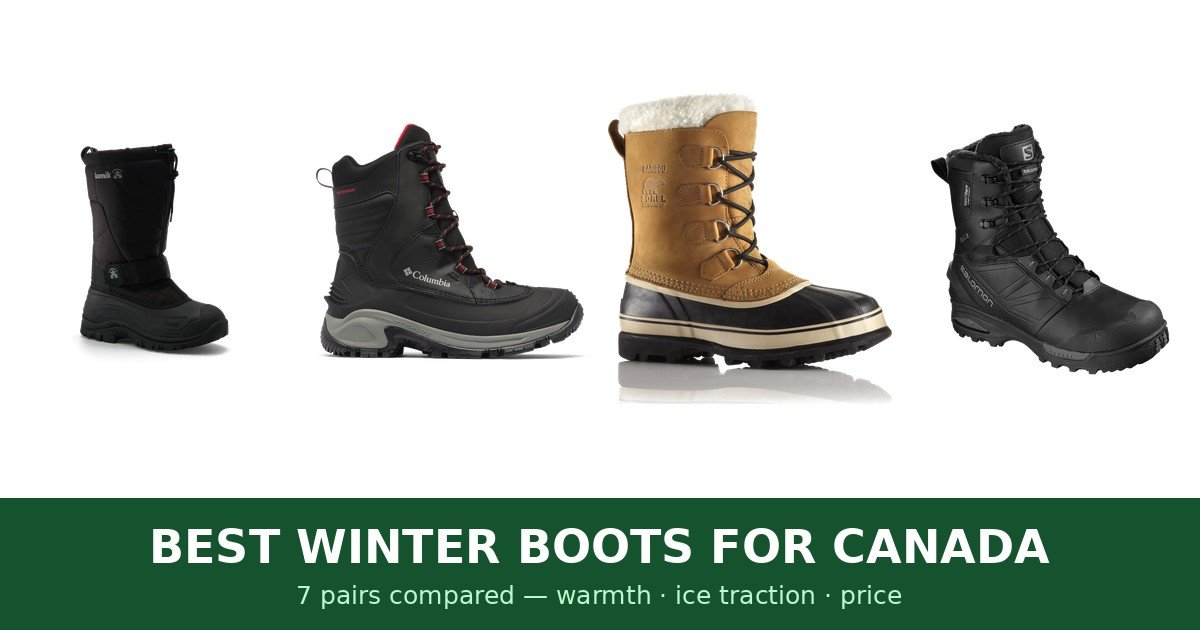
Regular hiking boots fail in a Canadian winter in predictable ways: insulation too thin for frozen ground, soles that harden and skate on ice, uppers that soak through in slush. The seven boots below are sold in Canada and all carry a manufacturer cold rating of −32 °C or lower, each suiting a different trip, from cleared sidewalks to a frozen lake at −40 °C.
How we chose: the criteria for winter boots
Our editors wear these boots on their own Canadian trips, and every pick is cross-checked against manufacturer and Canadian retailer specifications plus verified buyer feedback from retailer pages. Every boot is assessed against the same eight criteria, chosen for winter boots specifically:
Temperature/comfort rating — the manufacturer’s rating; brands test differently, so treat it as a rough scale.
Ice traction — outsole material and lug design; soft winter rubber compounds grip better than hard soles in the cold.
Waterproofing construction — seam-sealed upper, waterproof membrane/bootie, moulded shell, or waterproof base only.
Insulation type and weight — felt liners (mm), synthetic fill (grams), aerogel, or multi-layer liner systems; removable liners dry overnight, fixed insulation does not.
Shaft height — how much snow it keeps out before you need gaiters.
Weight per boot — matters on long walking days and in your luggage allowance.
Room for thick socks and fit notes — including sizing behaviour reported by buyers.
Ease of putting on and removing — laces, straps and buckles behave differently with cold hands and mitts.
Price tiers used in this guide (CAD): Budget — under $150; Mid-range — $150 to $260; Premium — over $260. Prices checked on Canadian retailer/manufacturer pages on November 1, 2026; they change often.
For deep snow and rural trips
CANADA VISITOR HUBTRAVEL GEAR PICKS
★ BEST BUDGET PICK
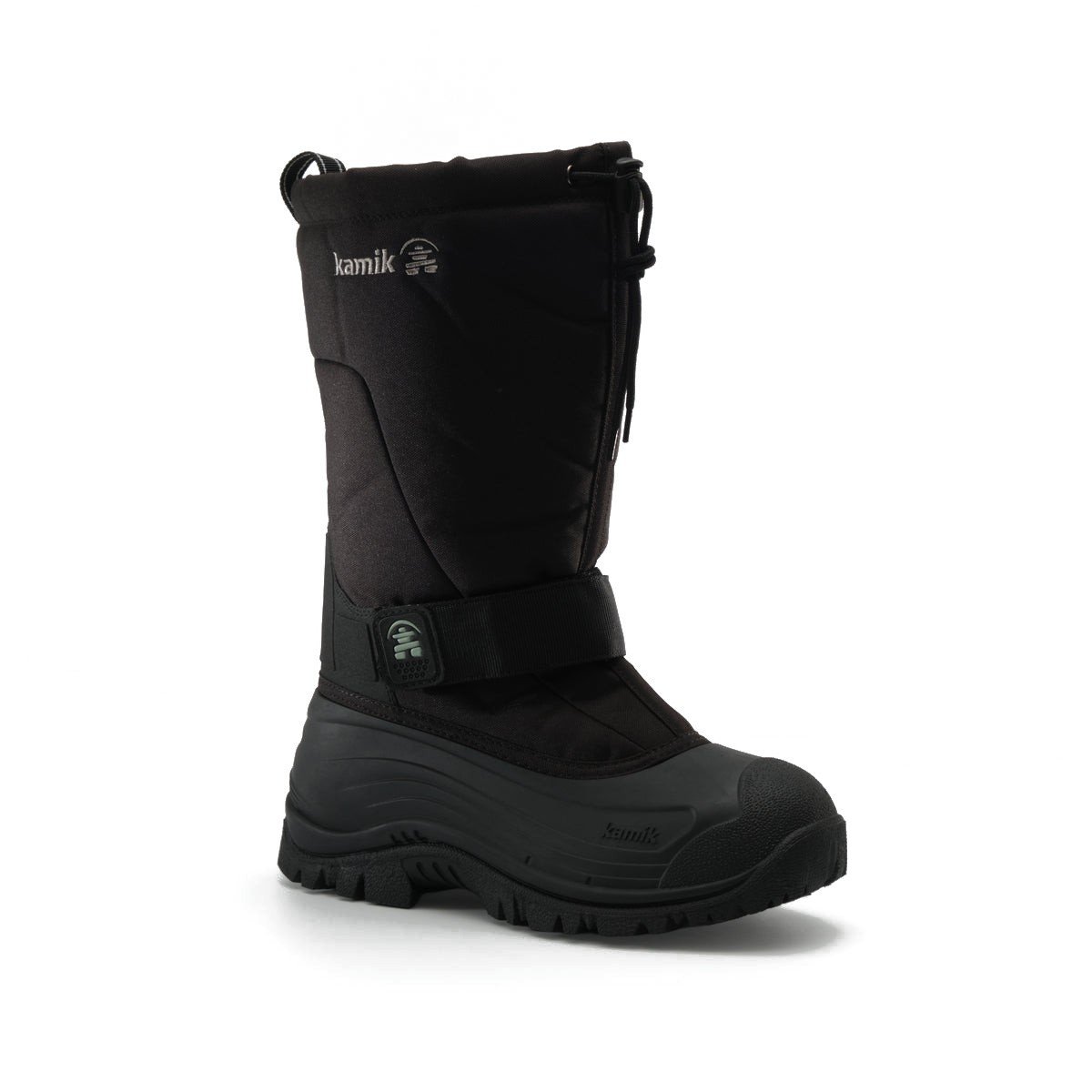
Kamik Greenbay 4
Best for: deep snow and rural trips on a tight budget · Price tier: Budget · Price: $119.99 at kamik.com
CANADA SPEC
Rated −40 °C · 8 mm Thermal Guard removable liner · Waterproof rubber shell · GRIP XT winter rubber outsole
Insulation: 8 mm Thermal Guard removable liner (100% recycled content)
Shaft height: 34.9 cm / 13.75 in (men’s size 9)
Weight: about 923 g per boot (1,846 g per pair, size 9)
Fit and thick socks: tall, roomy pac-boot fit, whole sizes 7–15; room for heavy socks
On/off: hook-and-loop midfoot strap plus drawcord top — no laces, works with mitts on
Why we picked it: It is the only boot here that pairs a full −40 °C rating with a price under $120, and it does so without cutting the corners that matter in deep snow — an 8 mm removable liner, a 34.9 cm shaft, and a moulded waterproof shell where the slush actually hits. The strap-and-drawcord closure scores on the ease-on/off criterion in a way laces do not: it works with mitts on, at a rural mailbox, in wind. The trade-off it wins is warmth per dollar, and nothing else in this list is close on that measure. The trade-off it accepts is weight — 923 g per boot — and a soft nylon upper with little ankle support.
✓ Pros
✗ Cons
The lowest price here for a −40 °C rating
The removable liner dries overnight
The strap closure is fast with frozen fingers
Heavy per boot
The soft nylon upper gives little ankle support
Whole sizes only
Editor’s take: On paper, the strap closure is the detail that won me over — no lace knots to pick at wearing mitts. What I would watch is the fit: whole sizes only, in a roomy pac-boot shape, so feet between sizes may swim. For a cottage, a woodpile and a frozen lake, this is where I would start; for long walks, keep reading.
FIELD NOTE — JAMES CARTER
Our cottage sits at the end of a lane the plow reaches when it feels like it, so the Greenbay has become the boot that lives by the woodstove. The ritual: mitts on, strap yanked tight, out into snow up to the top of the shaft for firewood. It is not a graceful boot — at over 900 grams a side you clomp, and the whole lane knows you are coming. But the strap is the thing. At minus twenty-eight, wind working down the lake, I have never once had to take a mitt off and pick at a frozen lace knot. The liner comes out at night and dries by the stove while we play cards; by morning it is warm before my feet are. Twice I have postholed through the crust carrying an armload of maple and felt the soft upper fold — there is no ankle support to speak of, and on a long walk you would notice. For the woodpile, the mailbox and the frozen lake, though, this is the boot I reach for without thinking, and at this price I do not baby it.
Waterproofing: seam-sealed waterproof construction; waterproof nylon upper over a RubberHe shell
Insulation: 145 g Heat-MX removable liner
Shaft height: 27.9 cm / 11 in
Weight: about 815 g per boot (3.6 lb per pair, men’s size 9)
Fit and thick socks: lace-up fit in whole sizes; removable liner means you can trade liner thickness for sock room
On/off: full lace-up — slower than the Greenbay’s strap, but a closer fit for walking
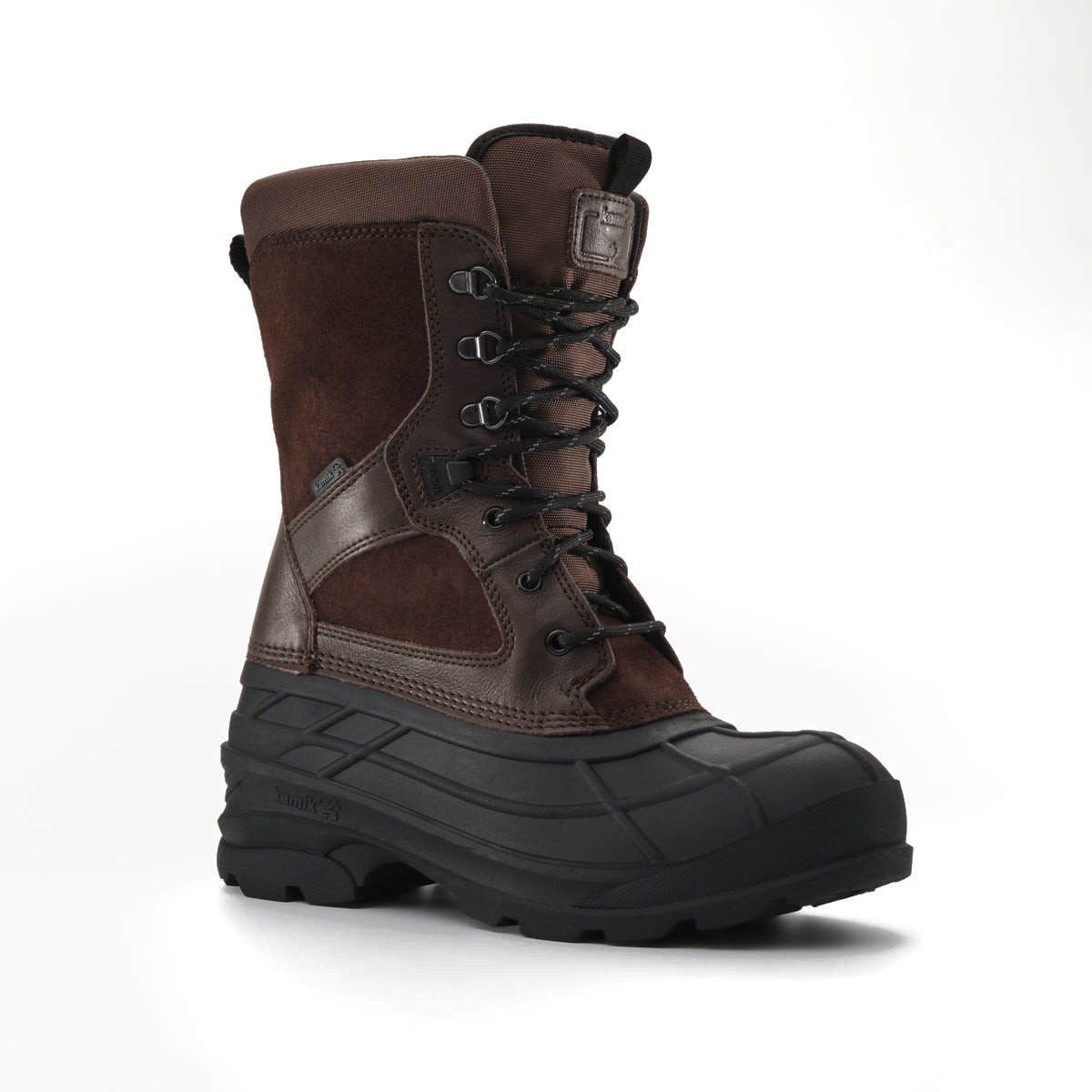
Why we picked it: It is the boot that gives up the least. Same −40 °C rating and removable liner as the Greenbay 4, but with seam-sealed waterproofing over the whole upper — the Greenbay’s protection stops at the shell — plus a proper lace-up fit and roughly 100 g less per boot. Run it down the eight criteria and it is the only mid-priced boot with no weak line: rating, waterproofing, insulation, weight, all present. The trade-off it accepts is a shorter 27.9 cm shaft that lets deep drifts spill in, and laces that are slow with mitts on.
✓ Pros
✗ Cons
A balanced all-rounder — warm rating, real waterproofing, moderate weight, fair price
The seam-sealed build handles slush well
Laces are slow with mitts
The shorter shaft lets deep drifts spill in
Editor’s take: If someone asked me for one boot with no follow-up questions, this is the one I would name: never the best at any single thing, second-best at almost all of them. The detail I would check against your trip is that shaft — 11 inches is plenty until you are postholing through knee-deep snow to a cabin door.
FIELD NOTE — JAMES CARTER
Churchill, late October. A visitor from Texas tried to do bear season in running shoes; he lasted one morning, and I lent him my spare socks out of pity. I was in the Nation Plus, standing on sea ice at the edge of town while a sow and two cubs decided whether we were worth a closer look. Forty minutes of standing perfectly still — the test no lab runs — and the cold never once reached my feet. The laces, I will admit under oath, are a misery with mitts on; twice that week I gave up and stamped around with them half-tied like a kid late for school. But the seam-sealed upper meant the slush at the station platform stayed outside where it belonged, and back at the lodge the liners pulled out and dried by the heater overnight, every night. It is not the warmest boot I own or the lightest. It is the one that has never once made me think about my feet — and on a trip where the bears are the story, that is exactly what a boot is for.
Insulation: 200 g synthetic insulation (fixed, not removable)
Shaft height: not published on the retailer listing we checked
Weight: not published on the retailer listing we checked
Fit and thick socks: hiking-boot style lace-up fit with half sizes available
On/off: lace-up with back pull loop — Sporting Life notes it is easy on and off
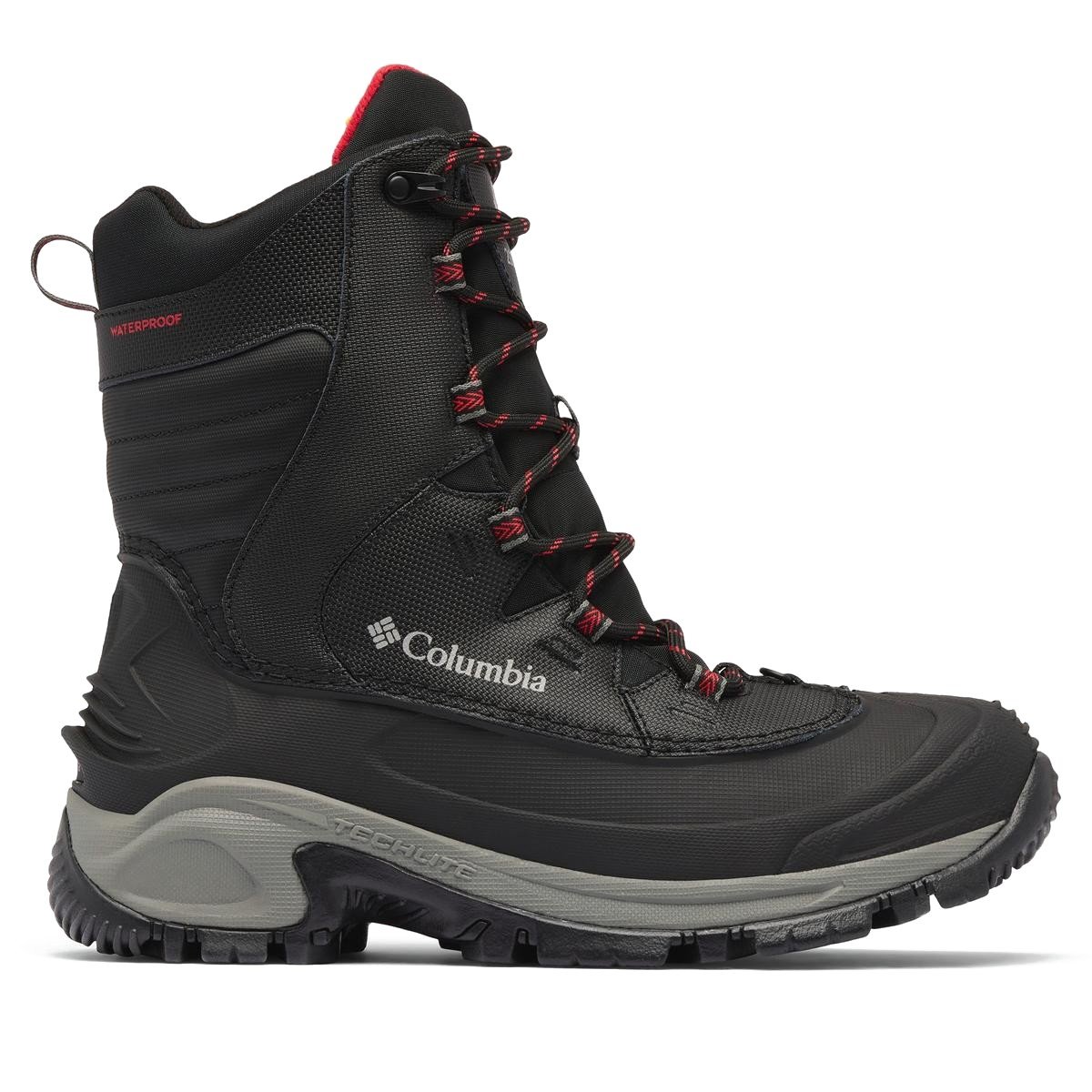
Why we picked it: It earns its slot on the two criteria city use actually tests — waterproofing and ease of on/off — rather than on headline warmth. The Omni-Tech membrane, waterproof leather and moulded shell are the most complete slush defence at this price, and Sporting Life specifically notes it is easy to put on and take off, which matters twice a day at a front door. Half sizes help, too: a commuter cannot afford a sloppy fit on pavement. The trade-off it accepts is the −32 °C rating, the joint-lowest here; in exchange, it looks and walks like a normal hiking boot instead of a pac boot.
✓ Pros
✗ Cons
Looks like a normal hiking boot — city-friendly without pac-boot bulk
Techlite midsole cushions long days on pavement
The membrane keeps slush out
−32 °C is the joint-lowest rating here — not the boot for a −40 °C week in Winnipeg
Fixed insulation dries slowly
Editor’s take: On paper this is a Toronto or Vancouver winter boot, not a Winnipeg one, and it does not pretend otherwise — I respect a spec sheet that knows its limits. What I would watch is the fixed insulation: a boot that gets damp on Friday is still damp on Monday.
FIELD NOTE — JAMES CARTER
Most of my winter is not the tundra. It is the 501 streetcar, a slush puddle the exact depth of a boot sole at King and Spadina, and a front door I go through twice a day. The Bugaboot is the boot that survives that winter without looking like it belongs on a trapline — nobody has ever glanced at my feet in a meeting. What I notice, months in, is the on-and-off: kicked off at the door with my hands full of groceries, pulled on half-asleep for the early train. No wrestling. The slush defence is real, too; Toronto salts its sidewalks into a grey soup that eats leather, and these shrug it off and hose clean. The honest limit showed up on a January trip to Winnipeg, where the wind at Portage and Main made the −32 rating feel like a rumour. This is a city boot wearing proper winter clothes — for the commute it is the right tool; for a cold snap on the prairies, it is not, and I pack accordingly.
Shaft height: not published on the retailer listing we checked
Weight: not published by the retailer; buyer reviews repeatedly describe it as heavy
Fit and thick socks: buyer feedback on the Altitude Sports listing is mixed — several say true to size, one sized down half a size; the felt liner leaves room for thick socks
On/off: lace-up pac boot; the liner pulls out for drying
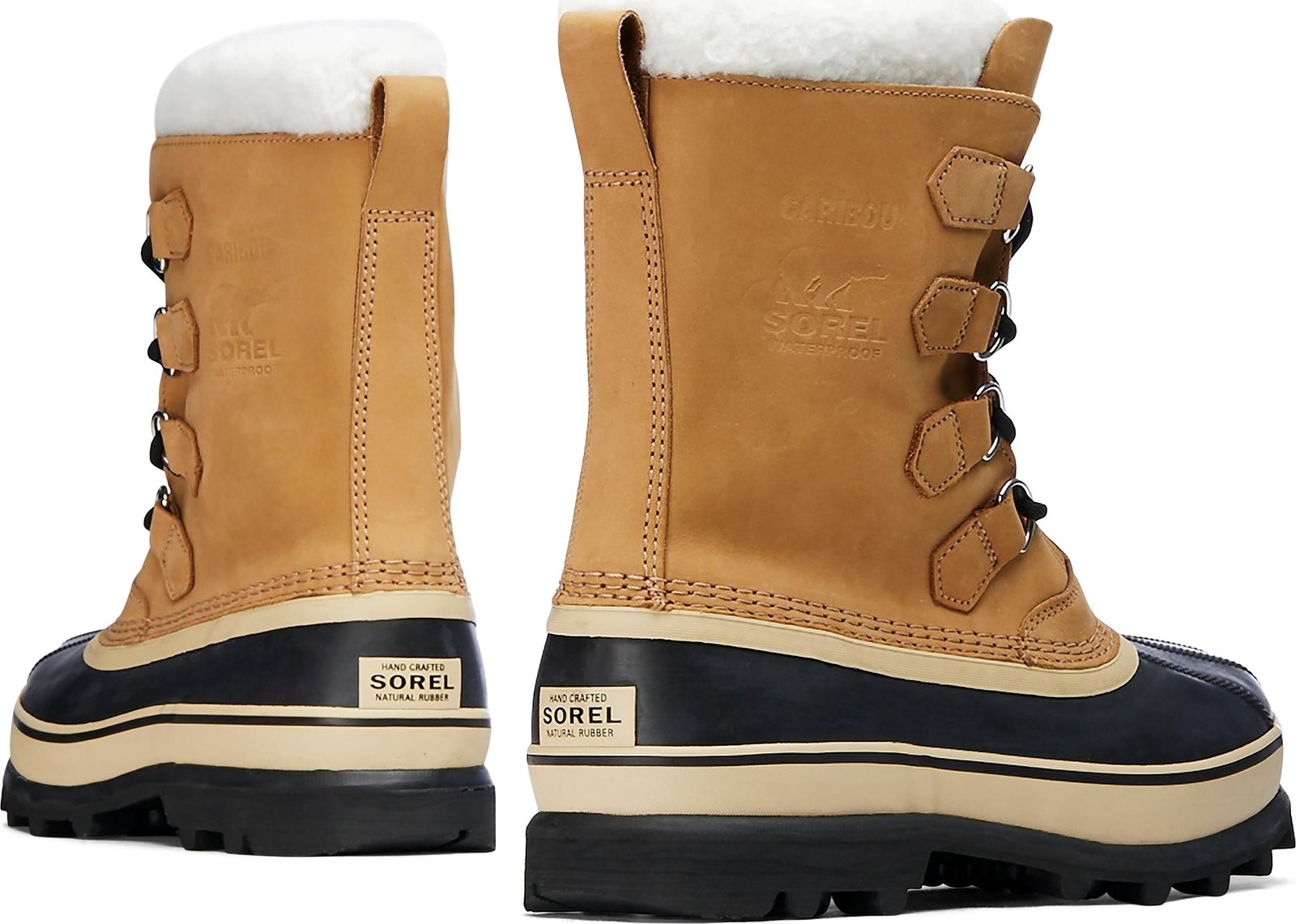
Why we picked it: This one is picked on track record more than spec-sheet wins. The baseline criteria are all covered — −40 °C rating, seam-sealed nubuck over a fully waterproof vulcanized shell, a removable 9 mm felt liner with a snow cuff — but the deciding evidence is that the design has been in production since 1972 and still holds 4.6 out of 5 from 181 buyers on the Altitude Sports listing. That is a lot of winters of feedback behind one boot. The trade-offs it accepts are weight, which buyers mention again and again, and a felt liner that packs down over seasons.
✓ Pros
✗ Cons
A design in production since 1972, strongly rated by buyers (4.6 out of 5 from 181 reviews on Altitude Sports)
Removable felt liner
Snow cuff
Heavy, by repeated buyer accounts
Near the top of the mid-range tier
Felt liners pack down over seasons
Editor’s take: The number that convinced me is 181 reviews at 4.6 — spec sheets can be gamed, but a decade of strangers’ winters is harder to fake. Sizing feedback on the listing is genuinely mixed, so I would order with returns in mind. If you want the boot that reads “winter in Canada” in every photo, this is it.
FIELD NOTE — JAMES CARTER
Some boots you wear; the Caribou you attend events in. Mine earned their keep at the Quebec Winter Carnival — eight hours on cobblestones and packed snow between the ice palace and the canoe race, in a crowd where every second person seemed to be wearing the same boot. There is a reason the design has not changed since 1972: the felt liner and that tall rubber shell simply work, and by the third hour my feet were the warmest part of me. The weight is the tax you pay. By nine o’clock, climbing the hill to the hotel, I felt every gram of them, and the felt liner had that end-of-day give that tells you it will pack down a little more each season. I do not hike in them. I do not commute in them. But for a winter festival, a Christmas market, a day of standing around looking at ice sculptures with people you love — this is the boot that looks like the postcard and keeps you out until the fireworks.
Price in CAD, checked November 2026 · Canada Visitor Hub may earn a commission on qualifying purchases, at no cost to you.
For winter hiking on snow-covered trails
CANADA VISITOR HUBTRAVEL GEAR PICKS
WINTER HIKING PICK
Keen Revel IV Polar
Best for: winter hiking and long walking days on packed snow and ice · Price tier: Mid-range · Price: $240.00 at Sporting Life and KEEN Canada
CANADA SPEC
Rated −32 °C · 200 g KEEN.WARM insulation · KEEN.DRY waterproof-breathable · KEEN.Polar Traction 5 mm lugs
Key specs
Temperature rating: −32 °C; the taller High Polar version: −40 °C, 400 g insulation ($250.00 at The Outfitters, women’s)
Ice traction: KEEN.Polar Traction rubber outsole with 5 mm multi-directional lugs
Waterproofing: KEEN.DRY waterproof-breathable membrane; waterproof leather and performance mesh upper
Insulation: 200 g KEEN.WARM recycled insulation, plus heat-trapping underfoot layers
Shaft height: ankle-height hiking cut (exact height not published in the listings we checked); the High Polar version adds height for deeper snow
Weight: 688 g per boot (men’s, Sporting Life); women’s High Polar 634 g (The Outfitters)
Fit and thick socks: KEEN Original Fit — KEEN describes it as generous across the forefoot, good for thick hiking socks
On/off: lace-up with pull tabs and a back notch for Achilles movement
Why we picked it: Winter hiking is the use case where pac boots genuinely fail — too heavy, too loose, no support — and this is the only boot here built on a real hiking platform: stability shank, cushioned midsole, and 5 mm multi-directional lugs in a cold-specific traction rubber. The fit point matters as much as the sole: KEEN’s generous forefoot is built-in room for thick hiking socks, which is one of our criteria, not a comfort footnote. At 688 g it is also the lightest boot here with conventional insulation. The trade-offs: the −32 °C rating assumes you are moving, the ankle-height cut leaves deep snow to the taller High Polar version, and there is no removable liner.
✓ Pros
✗ Cons
A real hiking platform (stability shank, cushioned midsole)
Lighter than the pac boots
Well reviewed on KEEN Canada’s site (4.3 out of 5, 234 reviews, women’s)
The −32 °C rating is for moving, not standing around
Leather needs basic care
No removable liner
Editor’s take: What won me over is that KEEN rates this boot for what it is — a hiker’s boot for cold trails, not a −40 °C standing boot — and the review count on KEEN’s own site backs the walking part up. I would steer aurora watchers standing on a frozen lake away from it, and anyone planning a long snowshoe day toward it.
FIELD NOTE — JAMES CARTER
The pac boots in this list are wonderful armchairs and terrible hiking boots, so for the Johnston Canyon icewalk — catwalks bolted to the canyon wall, packed snow, a minus-fifteen morning — I took the Keens, and the difference is not subtle. There is a shank. There is a midsole. Your feet roll instead of slapping. The wide forefoot swallowed my thickest hiking socks without the toe-pinch that makes winter walks go numb, and the cold-rubber lugs bit on the polished path up to the upper falls, where the pac-boot crowd was doing the penguin shuffle. Two honest notes: the −32 rating is a moving rating — stop for twenty minutes of photographs at the falls and you will feel the cold start to negotiate — and the leather wants a wipe and a wax now and then, which my Kamiks have never once asked for. Six kilometres later, back at the parking lot, my legs felt like they had done a hike, not a punishment. For winter trails, it is not close.
Price in CAD, checked November 2026 · Canada Visitor Hub may earn a commission on qualifying purchases, at no cost to you.
CANADA VISITOR HUBTRAVEL GEAR PICKS
★ BEST LIGHTWEIGHT
Salomon Toundra Pro CSWP
Best for: active use in deep cold — snowmobiling, winter work, fast-moving days · Price tier: Premium · Price: $279.95 at The Outfitters
CANADA SPEC
Rated −40 °C · Aerotherm Aerogel insulation · Full ClimaSalomon waterproof bootie · Only 450 g per boot
Key specs
Temperature rating: −40 °C (Salomon)
Ice traction: Winter Contagrip W compound, aggressive tread, made to grip at freezing temperatures
Waterproofing: full ClimaSalomon waterproof bootie — the most complete waterproofing here
Insulation: Aerotherm Aerogel (a thin aerogel layer, not a thick lofted fill)
Shaft height: not published on the retailer listing we checked
Weight: 450 g per boot (manufacturer spec via The Outfitters) — the lightest boot here
Fit and thick socks: standard fit (Salomon); the slim aerogel layer leaves more room inside than a felt liner
On/off: regular laces; gusseted tongue keeps snow out
Why we picked it: It wins two criteria outright, and no other boot is close on either: weight — 450 g per boot on Salomon’s spec, about half a pac boot — and waterproofing, a full ClimaSalomon bootie rather than a membrane panel or a waterproof base. The thin aerogel insulation is how it holds a −40 °C rating without a bulky liner, and it leaves more room inside for the foot as a side effect. For active days — snowmobiling, winter work, moving fast between stops — that profile is exactly what the criteria reward. The trade-off it accepts is the premium price, plus a sealed build Salomon itself rates 1 out of 5 for breathability.
✓ Pros
✗ Cons
−40 °C warmth at roughly half the pac boots’ weight
Full waterproof bootie
Built for movement (Salomon positions it for snowmobiling and cold-weather work)
Premium price
Salomon rates its breathability 1 out of 5, so feet can get clammy on mild days
Thin aerogel is not the reassuring choice for hours standing still at −40 °C — see the Baffin below
Editor’s take: On paper, this is the one I would trust at −40 °C if I had to keep moving — the weight figure is the whole argument. That 1-out-of-5 breathability score is Salomon’s own, and I believe it: this is a sealed system, and feet can cook in it during a mild, wet week. Standing still in deep cold is a different job, and the next boot does it better.
FIELD NOTE — JAMES CARTER
The first time you pick up the Toundra you check the box for the other one — 450 grams feels like a mistake, like someone forgot the insulation. Then a snowmobile day out of Whitehorse rewrites your assumptions: eight hours of climbing on and off the sled, kicking steps into drifted cutlines, standing in overflow slush at a creek crossing — and the full waterproof bootie kept the slush out while the aerogel kept the cold out. Light boots change how you move; by mid-afternoon I was still volunteering to break trail. The trade showed up the following day, a mild −6, when my feet ran clammy inside that sealed bootie — Salomon rates the breathability one out of five, and they are not being modest. And I would not choose it for an evening of standing still at −40; thin insulation asks you to keep moving. As an active boot, though — sled days, winter work, fast travel between cold places — nothing else here is in its weight class, literally.
Price in CAD, checked November 2026 · Canada Visitor Hub may earn a commission on qualifying purchases, at no cost to you.
For extreme cold and standing still
CANADA VISITOR HUBTRAVEL GEAR PICKS
★ BEST FOR EXTREME COLD
Baffin Impact
Best for: extreme cold at low activity — aurora watching, ice fishing, northern trips · Price tier: Premium · Price: $290.00 at baffin.com (sold out there at checking; also sold by other Canadian boot retailers)
CANADA SPEC
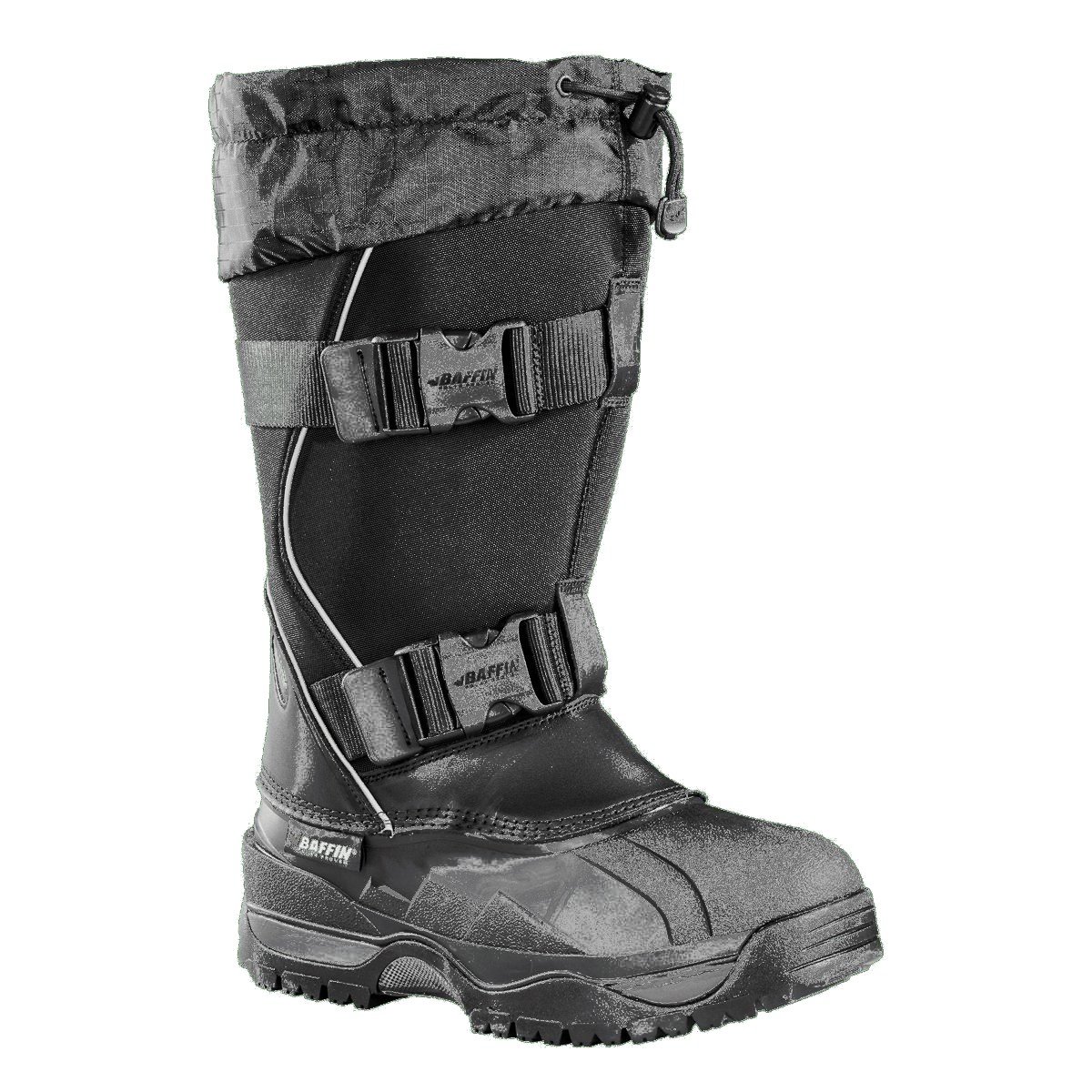
Polar Rated, comfort −45 to −60 °C · Multi-layer removable inner boot · Tallest here at 15 in · Double-buckle, snowshoe compatible
Key specs
Temperature rating: Polar Rated — Baffin describes comfort from −45 °C to −60 °C at moderate activity, and markets the inner boot system to −100 °C
Ice traction: Polar Rubber outsole, a cold-flexible rubber compound made for grip at very low temperatures
Waterproofing: B-Tek Dry Waterproof Base — note this protects the base; the tall leather-and-nylon upper is not a full waterproof membrane
Shaft height: 15 in — the tallest boot in this list
Weight: about 1.68 kg per boot (7.42 lb per pair, men’s size 9) — by far the heaviest here
Fit and thick socks: runs small — Baffin says choose one full size up; the liner is the insulation, so socks stay thin
On/off: double-buckle fastening, locking snow collar — no laces to tie with mitts on; snowshoe compatible
Why we picked it: Extreme cold at low activity is the use case where every other boot in this list runs out of insulation, and the Impact’s removable multi-layer inner boot is the deepest system here — Baffin’s Polar Rated class covers comfort from −45 °C to −60 °C at moderate activity. It also tops two supporting criteria: the tallest shaft in the list at 15 inches, and a double-buckle closure with a locking snow collar that heavy mitts can actually operate. The trade-offs are not subtle — about 1.68 kg per boot, and waterproofing that protects the base only. It wins the standing-still warmth criterion by a margin nothing else approaches, and that is the entire reason it is here.
✓ Pros
✗ Cons
The warmest class here, built for extended time in extreme cold at low-to-moderate activity
Tall shaft
Buckles work with heavy mitts
Very heavy — you feel every step on a long walk
Waterproofing covers the base only
Overkill for a city trip
Editor’s take: I will not pretend this is a walking boot — at 7.42 lb a pair, the spec sheet reads like equipment, not footwear, and that is the point. The detail I would respect most is Baffin’s own sizing note: go a full size up, because a squeezed foot defeats all that insulation. For a night standing on a frozen lake watching the sky, it is the one on this list I would want between me and the ice.
FIELD NOTE — JAMES CARTER
Aurora watching is a contact sport played by standing still. On a frozen lake outside Yellowknife at two in the morning, −44 on the photographer’s thermometer, the sky doing its green slow-motion fireworks, you do not pace, you do not stamp — you stand, and you wait, and the cold comes up through the ice like it is looking for you. The Impact is built for exactly that insult. The multi-layer inner boot swallowed it whole; my toes stayed merely cold, which at −44 counts as comfort. The buckles deserve their own sentence: I fastened them wearing the heaviest mitts I own, the kind that make you useless at everything, and the locking collar sealed the top against the drifted snow on the walk out. The walk out is the catch — at roughly 1.7 kilos a boot, crossing that lake felt like marching in diving weights, and my calves filed a formal complaint. In town the next day I switched to ordinary boots and felt reborn. But for the hours that mattered, out on the ice, nothing else in this list was even a candidate.
Three honest cautions. First, brand temperature ratings assume you are active and dry — standing still on ice at −30 °C can feel colder than walking at −40 °C. Second, the sock matters: wear a thick merino hiking sock in a boot roomy enough for your toes to move — a tight boot is a cold boot. Third, removable liners matter: a liner you can dry overnight means warm feet on day three, not damp ones. If your trip is mostly city walking with one cold excursion, buy for the city days and borrow for the extreme one.




5 comments