
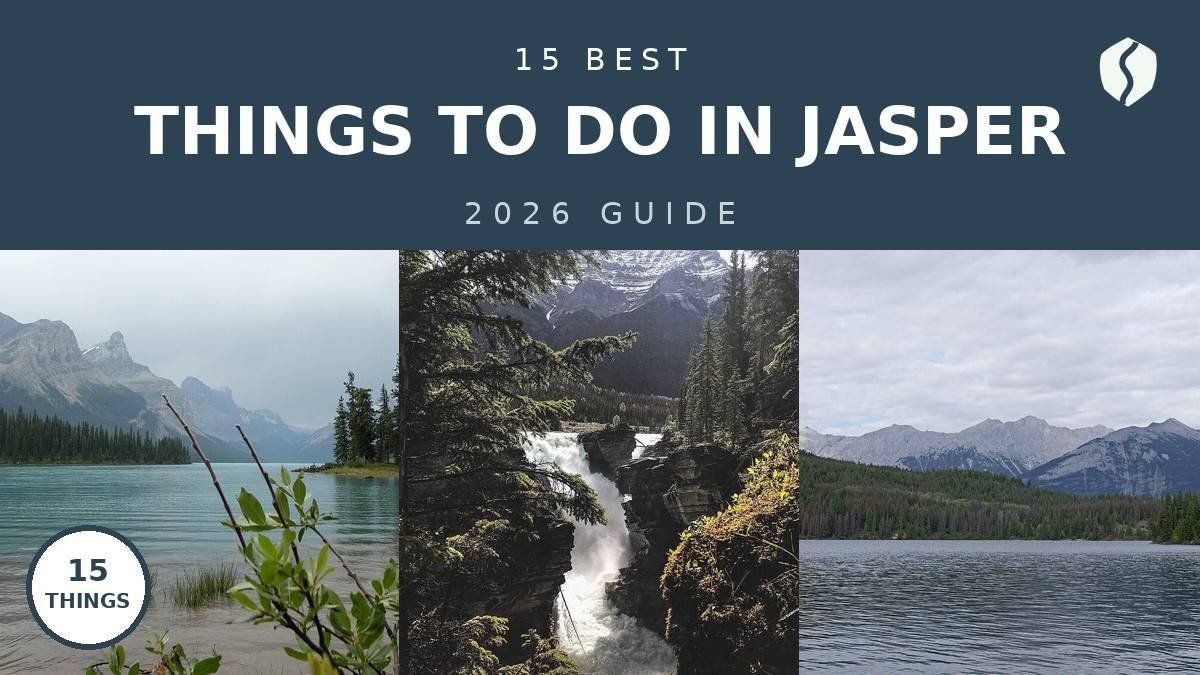
- ✓ Do the Maligne Valley as one leg: Medicine Lake, Maligne Lake and the wildlife drive stack into a single 48-kilometre run from town — don’t split them across days.
- ✓ Book the two big tickets early: the Maligne Lake cruise and the SkyTram both sell out on summer weekends, and neither has a standby line worth standing in.
- ✓ One thing is still closed: Maligne Canyon stays shut for the 2026 season after the 2024 wildfire — everything else on this list is open, and the canyon has good stand-ins below.
Here’s the deal with Jasper: it’s the Rockies without the Banff crowds and without the Banff traffic. Same scale of mountains, same impossible lakes, and a townsite you can actually walk across in ten minutes. I came for a weekend and stayed four days, mostly because I kept adding “one more pullout” to every drive. The fifteen stops below are the ones I’d hand to anyone with three days and a full tank. Every price and opening fact was checked in October 2026 — and where Jasper is still rebuilding after the 2024 wildfire, I say so plainly instead of guessing.
First, the wildfire question, because everyone asks it. The July 2024 fire burned roughly a third of the townsite and a big stretch of the park. I double-checked the current picture on the official Parks Canada site before writing this: virtually all of Jasper’s trails have now reopened, including the Valley of the Five Lakes, and the town’s hotels, restaurants and services are running. Two exceptions remain for the 2026 season — Maligne Canyon and Cavell Road — and I’ve marked the canyon clearly below. Check the Parks Canada recovery page before you go, because closure lines move as repair work finishes. → Parks Canada — Jasper park recovery
Getting around Jasper
You need a car here. No joke — this is not a transit town. The Maligne Lake road runs 48 kilometres one way, Miette Hot Springs sits 61 kilometres east, and the Icefields Parkway stops are strung out over 30-plus kilometres south. I drove it all in a small rental with a fuel gauge I did not entirely trust, and the one thing I’d do differently is gas up in town before every leg. There’s no station at Maligne Lake and none at Miette. The townsite itself is walkable, and there are seasonal shuttles to the SkyTram and Maligne Lake, but for the full list below, a car is the move.
The park pass is separate from every ticket below. Parks Canada charges $12.25 per adult per day (family/group $24.50 per vehicle), and the annual Discovery Pass runs $83.50 per adult — it pays for itself after about seven park days. Youth 17 and under are free. I double-checked those numbers on the official Parks Canada fees page. → Parks Canada — Jasper fees
The 10 must-see stops, on a map
Ten stops, from Miette Hot Springs in the east to Sunwapta Falls in the south. Tap any stop to jump the map straight to it.
Map data © OpenStreetMap contributors. Open the full map
1. Maligne Lake cruise to Spirit Island — the one photo everyone wants

Maligne Lake is the largest natural lake in the Canadian Rockies, and the 90-minute cruise to Spirit Island is the single most popular paid thing in Jasper — for good reason. The boat runs 14 kilometres down the lake through Samson Narrows, the water gets bluer as you go, and then there it is: a tiny tree-covered point backed by peaks, the most photographed island in the Rockies. You don’t land on the island itself; you get about 15 minutes at the viewpoint. That’s enough. I spent most of mine just standing there quietly, which is not my usual mode.
Tickets run from about $85 per adult and the season runs roughly late May to early October — the lake freezes, so winter visitors are out of luck. Book ahead in July and August. The cruise does not include the drive: the dock sits 48 kilometres from town at the end of Maligne Lake Road, and there’s no public bus. Gas up before you leave town. I’ve made this mistake so you don’t have to — I watched my gauge drop on the way back and did the last ten kilometres in silence, bargaining with the dashboard.
Sit on the upper deck if the weather holds — the glassed-in lower deck is warmer but the photos are worse. And leave the bear spray in the car: it’s not allowed on board.
2. Jasper SkyTram — seven minutes to the alpine

Canada’s longest and highest aerial tramway runs 7 minutes from the valley floor to the upper station on Whistlers Mountain at 2,263 metres. From there it’s a boardwalk and, if you’re feeling strong, the 1.4-kilometre Whistlers Summit Trail to 2,463 metres and a six-range panorama. I did the summit trail in a wind that tried to take my hat twice. Worth it. The upper station is about 12 degrees cooler than town on average, so bring a layer even in July — I didn’t, and paid summit-café prices for a sweater’s worth of hot chocolate instead.
Adult return tickets run about $80, and the season runs roughly mid-April to late October — check the operator’s site for the exact dates, because the last ride up leaves well before closing. If you’re building a longer Rockies drive around this, my Icefields Parkway itinerary pairs the SkyTram with the glacier stops to the south.
3. Athabasca Falls — small drop, huge attitude

At 23 metres, Athabasca Falls is not tall. It doesn’t need to be. The Athabasca River — the largest river system in Jasper, fed by the Columbia Icefield — squeezes through a narrow gap in the rock and drops with enough force to have carved potholes and a short canyon out of the limestone below. I double-checked the height and the geology on the official Parks Canada site, and the short version is: stand on the viewing platforms, feel the spray, and stay behind the railings. The mist leaves the rocks slick. → Parks Canada — Athabasca Falls
It’s about 30 kilometres south of town on the Icefields Parkway, an easy stop with a short walk from the parking lot. No extra ticket beyond the park pass. In winter the falls partly freeze, which is worth the detour if you’re passing — just expect icy walkways.
4. Valley of the Five Lakes — the easy hike that earns its hype

Five lakes, one 5.4-kilometre loop (the Emerald Circuit), each a different shade of green and blue thanks to the glacial minerals in the water. This is the hike I’d give a first-timer, a family, or anyone who wants a big payoff without a big climb. The trail reopened in May 2026 after the wildfire, with a realigned section, better surfaces and new rest areas — and less shade than before, so bring a hat and water. I took a wrong fork near the third lake and added forty minutes to my loop. Zero regrets. The lakes were still there, and the detour had the best view of the day.
The trailhead sits on the Icefields Parkway about 9 kilometres south of town. Go early: the parking lot fills by mid-morning in summer, and this is one of the first trails locals recommend to everyone, so it’s never empty.
The fire changed the shade situation here. Sections that used to run under forest canopy are now open to the sun, and the burnt-trunk stretches get hot by midday. Sunscreen, a hat, and more water than you think you need.
5. Pyramid Lake & Pyramid Island — the quiet morning stop

Ten minutes from town, Pyramid Lake is where Jasper goes quiet. A wooden bridge crosses to Pyramid Island, a tiny treed island with a classic view back across the lake to Pyramid Mountain. I went at 7 AM with coffee from town and had the island to myself for half an hour, which is the whole trick with this place: it’s lovely at noon and empty at dawn. The lake is also a good easy paddle if you rent a canoe, and the Pyramid Bench trails above it connect to Patricia Lake for a longer walk.
No ticket, no crowds, no effort. Pair it with breakfast in town and you’ve used a morning well. If you’re deciding where to sleep in the first place, my where to stay in Jasper guide covers the townsite areas by budget.
6. Stargazing in the Dark Sky Preserve — Jasper after dark

Jasper is the world’s second-largest Dark Sky Preserve — over 11,000 square kilometres of it, designated by the Royal Astronomical Society of Canada in 2011 — and on a clear, moonless night the sky does something rude to your sense of scale. The Milky Way shows up without trying. If you’re lucky and it’s winter, so does the aurora. The Jasper Planetarium in town runs dome shows and telescope nights with the largest telescope in the Rockies, and the annual Dark Sky Festival runs each October (the 2026 edition ran October 16–25). Even without a ticket, just drive ten minutes out of town, turn the headlights off, and look up.
October and winter nights are the darkest and clearest; summer nights stay light late, so the show starts later. Dress warmer than you think — I stood at Lake Annette in October in a light jacket and lasted twenty minutes before retreating to the car heater. For the wider aurora picture, see my where to see the northern lights in Canada guide.
Pyramid Lake and Lake Annette are the easy dark-sky pullouts near town — flat, safe to park, and far enough from the streetlights. A local at the Planetarium told me the best nights are the cold, still ones right after a front passes, when the air scrubs itself clean.
7. Miette Hot Springs — the hottest water in the Rockies

The water at Miette comes out of the mountain at 54°C and is cooled to about 40°C in the pools — the hottest springs in the Canadian Rockies, and noticeably quieter than the Banff pools. The drive alone is worth it: 61 kilometres east of town through the Fiddle Valley, with good odds of bighorn sheep on the road. Single entry runs $19.75 per adult, tickets are in person only (no online booking), and you still need a park pass on top.
Here’s the catch, and it’s seasonal: Miette runs roughly May to mid-October, and Parks Canada confirms it is now closed for the season, reopening in spring 2027. So if you’re reading this in winter, file it for the summer list and don’t drive the 61 kilometres to a locked gate. The narrow Miette Road isn’t maintained in winter, which is the whole reason. → Parks Canada — Miette Hot Springs
8. Maligne Canyon — closed for 2026, and what to do instead

I’m including Maligne Canyon because you’ll see it on every “best of Jasper” list ever written — and right now you can’t walk it. Parks Canada confirms Maligne Canyon stays closed for the 2026 season while it assesses and plans rehabilitation after the wildfire: the loss of trees on the steep slopes above the canyon raised the risk of debris flows and landslides. That’s not a suggestion. Respect the closure, don’t duck the barriers, and don’t go looking for a way in from another trailhead.
The good stand-ins: Athabasca Falls (section 3) for the raw-water drama, and the Valley of the Five Lakes (section 4) for the easy gorge-and-lake walk. The Maligne Lake road and the lake itself are open and unaffected — it’s only the canyon that’s shut. Check the Parks Canada recovery page before a future trip to see whether the canyon has reopened.
Cavell Road is closed for the 2026 season too, which means the Mount Edith Cavell meadows and the Angel Glacier viewpoint are not reachable by road. Don’t build a day around Cavell until Parks Canada says it’s back — check before you go, don’t assume.
9. Wildlife watching in the Maligne Valley — slow down, literally

Jasper’s wildlife is not a zoo exhibit; it’s a traffic condition. Elk graze the townsite lawns, bighorn sheep block the Miette road, and the Maligne Valley road at dawn and dusk is the best free show in the park — bears, moose, elk and deer all use the same corridor you’re driving. I spent twenty minutes in an elk traffic jam on the Maligne road one evening: a bull, two cows, and about fifteen cars all politely refusing to be the first to move. Nobody honked. That’s Jasper.
Rules that matter: stay in the car or at least 30 metres back from elk and 100 metres from bears, never feed anything, and drive the valley roads slowly at dawn and dusk. September and October are rut season, when bull elk are at their least reasonable — give them even more room, especially around town. A ranger at the visitor centre told me the same thing every local repeats: the animals were here first, and the road is theirs.
10. Athabasca Glacier & the Columbia Icefield — walk up to the ice
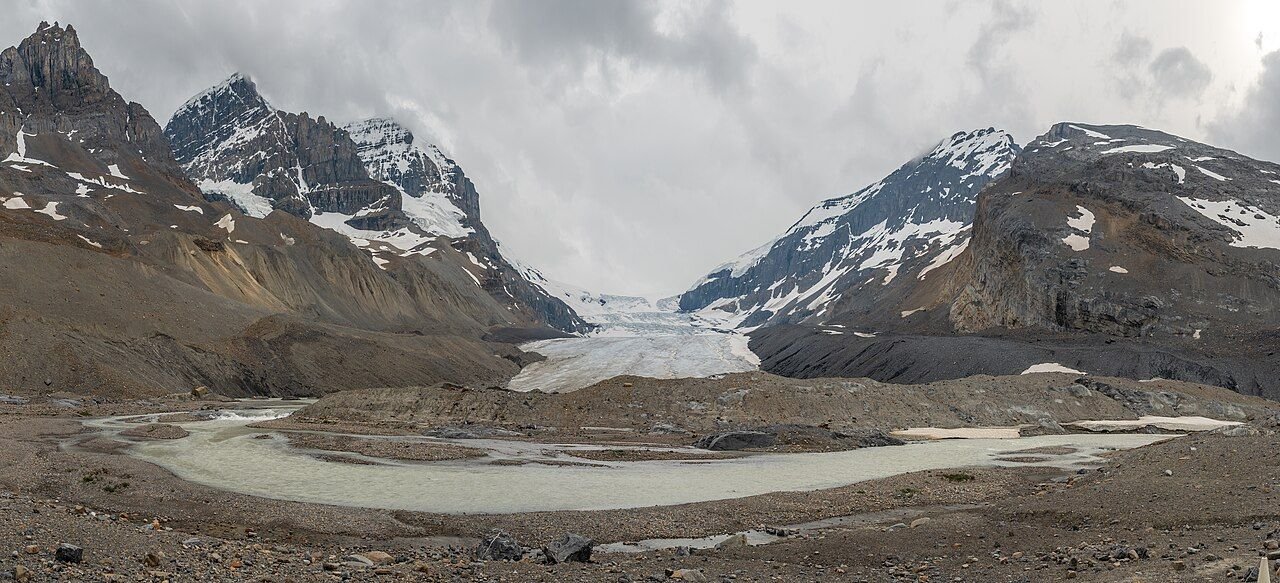
An hour south of town on the Icefields Parkway sits the Columbia Icefield, and the Athabasca Glacier is its most accessible tongue. You can see it from the road, walk the short toe-of-the-glacier trail to stand near the ice (behind the markers — the ice is receding fast and the ground near it is unstable), or take the Ice Explorer vehicle tour onto the glacier itself. The scale is the thing: the icefield covers more than 300 square kilometres, and standing under it shuts you up in a way few places do.
Worth the detour, even if you’re not doing the full Parkway. My Icefields Parkway itinerary covers this stop with the Sunwapta and Athabasca Falls stops in one southbound leg. If you’re weighing Jasper against the rest of the Rockies, my best time to visit the Canadian Rockies guide lays out the seasons month by month.
11. Sunwapta Falls — the Parkway stop everyone drives past too fast
Sunwapta Falls sits about 55 kilometres south of town on the Icefields Parkway, and it’s the waterfall stop that gets skipped because Athabasca Falls is closer. Don’t skip it. The upper falls drop through a narrow rock channel into a deep canyon, and the short trail network gives you the falls from above and from the canyon rim. It’s a twenty-minute stop if you’re in a hurry and an hour if you take the lower falls trail. I stopped for twenty minutes and stayed an hour. The lower falls trail is the quieter half — take it.
12. Medicine Lake — the lake that isn’t a lake
Medicine Lake, about 20 kilometres up the Maligne Valley road, is a geologic oddity: in summer it fills with glacial meltwater, and in fall and winter it drains away through sinkholes in the lakebed, vanishing underground through a cave system that resurfaces 16 kilometres away at Maligne Canyon. Yes — the same closed canyon. The water you’re looking at in July ends up feeding the canyon’s springs. Stop at the viewpoint on the way to Maligne Lake, read the interpretive sign, and look at the bathtub ring on the shoreline that shows where the water level sat. It’s a free stop, it takes ten minutes, and it’s the strangest thing on this list.
13. Jasper townsite — walk it, don’t just sleep in it
Jasper town is small enough to cross on foot and worth an unhurried half-day. Start at the Jasper Park Information Centre on Connaught Drive, walk the main drag for the outfitters and cafés, and stop at the Jasper Yellowhead Museum for the railway and park history — the town exists because the railway came through, and the museum tells that story straight. The Two Brothers Totem Pole across from the information centre and the old CN locomotive 6015 are the classic townsite photos. Evenings are for the patios: Jasper’s restaurant scene is small but serious, and after a day on the trails, a burger and a local beer on a patio with the mountains behind it is the correct ending.
14. Lake Annette & Lake Edith — the townsite beach day
Two small lakes ten minutes northeast of town, and the closest thing Jasper has to a beach. Lake Annette has a sandy shore, a grassy picnic area and a short lakeside trail; Lake Edith next door is the quieter of the two. In summer the water is cold — mountain-lake cold, no joke — but on a hot July afternoon half the town seems to be in it anyway. Bring a picnic, bring a towel, and bring the bear spray for the trail between the lakes. In winter both lakes freeze and the area turns into a cross-country ski and snowshoe loop, which is a different kind of good.
15. Old Fort Point — the short loop with the big view
Old Fort Point is the 3.8-kilometre loop I’d give someone with one free hour and tired legs. It climbs a small rocky hill right at the edge of town and pays off with a panoramic view over the townsite, the Athabasca River valley and the surrounding ranges. The trail is steep in places but short, and it’s a local favourite for a reason: maximum view per minute of effort. Go at sunset if the weather holds — the light on the valley is the kind that makes you stop taking photos and just stand there. I did exactly that, and then took three more photos anyway.
What does Jasper cost?
Prices below are what I checked or paid across my visits, converted to a per-person day plan. Pick your travel style, tell the calculator how many days you’re staying, and it does the rest. (Accommodation not included — see the table below for that.)
Budget calculator
Per person, in Canadian dollars. Excludes accommodation.
Budget ≈ $75/day · Mid-range ≈ $130/day · Luxury ≈ $230/day. Park pass and attraction prices checked October 2026.
| Expense (per person / day) | Budget | Mid-range | Luxury |
|---|---|---|---|
| Accommodation | $45 (hostel dorm) | $170 (townsite hotel) | $350+ (lodge / resort) |
| Food & drink | $35 | $60 | $110 |
| Sights (cruise, SkyTram, hot springs) | $15 | $35 | $60 |
| Getting around (car + park pass) | $15 | $20 | $35 |
| Coffee, treats & souvenirs | $10 | $15 | $25 |
| Daily total | ~$120 | ~$305 | ~$580 |
Wondering where to base yourself? My where to stay in Jasper guide breaks down the townsite areas by budget — spoiler: stay in town, near Connaught Drive, and you’ll thank yourself every morning.
Suggested 3-day plan
| Time | Day 1 — townsite + Pyramid | Day 2 — Maligne Valley | Day 3 — Icefields Parkway south |
|---|---|---|---|
| Morning | SkyTram at opening, summit trail | Medicine Lake viewpoint, wildlife drive | Valley of the Five Lakes loop |
| Midday | Pyramid Lake + Pyramid Island walk | Maligne Lake cruise to Spirit Island | Athabasca Falls + Sunwapta Falls |
| Afternoon | Townsite stroll + Yellowhead Museum | Lake Annette picnic + swim | Athabasca Glacier viewpoint |
| Evening | Dinner on a Connaught Drive patio | Dark-sky stargazing at Lake Annette | Old Fort Point sunset loop |
FAQs about things to do in Jasper
How many days do you need in Jasper?
Three full days covers this list comfortably — one day for the townsite, Pyramid Lake and the SkyTram, one for the Maligne Valley, and one for the Icefields Parkway stops to the south. With two days, cut the hot springs leg and the glacier stop. With four, add a second hike and a slow morning — Jasper rewards the unhurried.
Is Jasper open after the 2024 wildfire?
Yes. The town and the vast majority of the park are open, and Parks Canada confirms virtually all trails have reopened. Two exceptions remain for the 2026 season: Maligne Canyon and Cavell Road are closed while rehabilitation work is planned. Check the Parks Canada recovery page before you go, because closures change as work finishes.
Do I need a car in Jasper?
Yes, for the full list. The townsite is walkable, but Maligne Lake is 48 kilometres away, Miette Hot Springs 61 kilometres, and the Parkway stops are spread over 30-plus kilometres south. There are seasonal shuttles to the SkyTram and Maligne Lake, but a car is the practical way to do Jasper. Gas up in town before every leg — there are no stations at the trailheads.
What is the best time of year to visit Jasper?
June through September is the sweet spot: every seasonal attraction is open, the lakes are full, and the hiking is at its best. July and August are the busiest. I’m partial to September — thinner crowds, rut season wildlife, and the larch turning. Winter is a different trip entirely: skiing at Marmot Basin, frozen falls, and the darkest skies of the year. For the month-by-month breakdown, see my best time to visit the Canadian Rockies guide.
How much does Jasper cost per day?
A mid-range day runs about $130 per person excluding accommodation (see the calculator above), plus the park pass at $12.25 per adult per day. The budget-killers are the cruise (about $85) and the SkyTram (about $80) — do one big ticket per day and the rest of the list is mostly free hiking, lakes and viewpoints. The Discovery Pass at $83.50 pays for itself after about seven park days.
Can you see the northern lights in Jasper?
Yes, especially in winter. Jasper is the world’s second-largest Dark Sky Preserve, and on clear, dark nights the aurora shows up regularly from fall through spring. Summer nights stay light too late for reliable viewing, so winter is the aurora season. The Planetarium runs guided telescope nights year-round, and the free option — drive ten minutes out of town and look up — works just as well on a clear night.
Keep exploring
Jasper is just the start — here’s where I’d go next:
- Where to stay in Jasper — townsite areas by budget
- Icefields Parkway itinerary — the Jasper-to-Banff drive, stop by stop
- Best time to visit the Canadian Rockies — month by month
- Where to see the northern lights in Canada — the aurora map
- Waterton Lakes National Park guide — the other Alberta park worth the drive
- 15 best national parks in Canada — where Jasper ranks
Gas up, drive slow through the valley, and look up at night. Jasper does the rest.