
Last updated: October 14, 2026
- ✓ US dollars don’t work here: a few border-town shops accept them at a punishing rate — get Canadian dollars and skip the math penalty.
- ✓ Cards beat cash almost everywhere: Visa and Mastercard are near-universal and tap-to-pay works at most terminals — but keep $40–60 in cash for tips, markets, and small towns.
- ✓ Two numbers to remember: a Canadian bank ATM costs roughly 2–4% over the exchange rate, while the airport kiosk I used on arrival cost me closer to 11% — and anything over $10,000 CAD gets declared at customs.
I landed at Toronto Pearson with a wallet full of US dollars and the confident assumption that Canada — polite, nearby Canada — would just take them. Reader, it did not go well. The coffee stand past customs stared at my American fiver like Monopoly money, and I exchanged $200 at the first kiosk I saw, feeling efficient. That efficiency cost me about $22 in margin versus the bank ATM across the hall — I found out the expensive way. Here’s the thing: Canadian money has its own logic — the loonie, the toonie, the vanished penny, the tax that isn’t on the price tag — and once you learn it, it’s easy. This is the guide I wish someone had handed me at arrivals, with every rate, fee, and rule checked in October 2026.
Meet the Canadian dollar
Canada’s currency is the Canadian dollar — code CAD, symbol $. Yes, it shares the dollar sign with its American cousin, which is exactly how the confusion starts. Bills come in $5, $10, $20, $50, and $100, all printed on smooth polymer (they survive the washing machine, trust me on this one). The $10 is even printed vertically, honouring civil rights pioneer Viola Desmond. I double-checked the current series on the Bank of Canada’s official bank notes page before writing this. → Bank of Canada — bank notes

The coins are where it gets fun: the $1 coin is the loonie (there’s a loon on it — the bird, not the adjective), the two-toned $2 is the toonie, with 25¢, 10¢, and 5¢ below. And the penny? Gone — Canada retired it in 2013, so cash totals round to the nearest nickel ($1.02 becomes $1.00, $1.03 becomes $1.05). Cards still charge to the exact cent: one more quiet reason to tap instead of counting change at a Tim Hortons drive-through.

Get $100–150 CAD from your home bank before you fly. The rate won’t be the world’s best, but you’ll land with taxi money, coffee money, and zero reason to touch an airport kiosk. I order mine a week ahead — my bank needs 3–5 business days and charges no fee on orders over $200.
Nobody misses the penny, and the rounding rule has a tiny silver lining: totals ending in 1, 2, 6, or 7 round down. A cashier in Ottawa told me the first week after pennies died in 2013, everyone argued about it at the till. Now? Nobody thinks twice — except tourists, who stare at the register like it’s broken. You’re welcome for the warning.
Five money stops, on one map
Money has landmarks in Canada — a free museum about currency, the actual mint where the loonies are born, and the airport kiosk I’d like you to walk straight past. Tap any stop to jump the map to it.
Map data © OpenStreetMap contributors. Open the full map
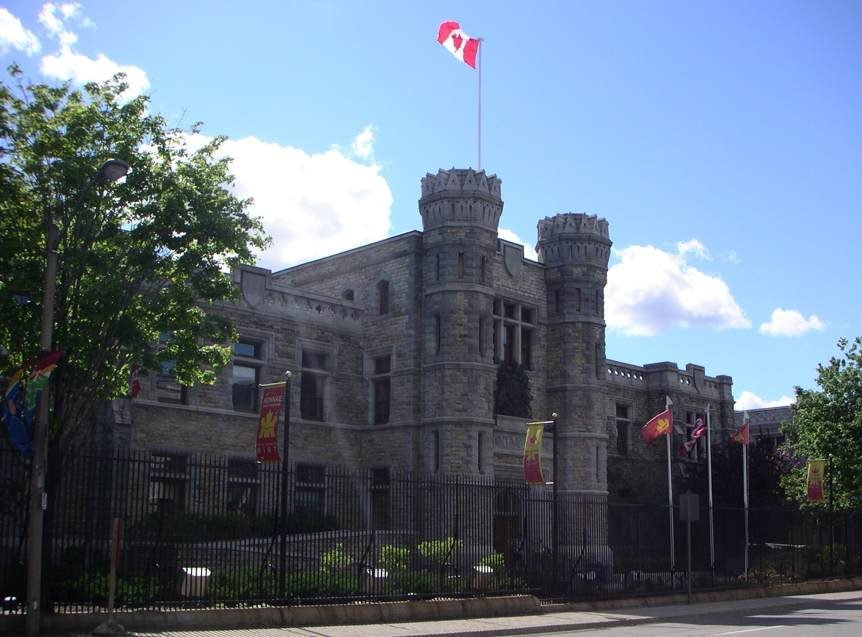
Two stops deserve more than a map pin: the Bank of Canada Museum sits across from Parliament Hill — free, bilingual, and far more fun than “currency museum” sounds — and the Royal Canadian Mint on Sussex Drive is where every loonie in your pocket was born. I checked tour times on the Mint’s official site before my visit (English and French tours; the gift shop will tempt you). → Royal Canadian Mint — official site

Where to get Canadian dollars (without getting fleeced)
You have four doors into Canadian cash, and they are not created equal — ranked below from best to worst, by what I actually paid:
| Method | Typical margin over the real rate | Speed | My verdict |
|---|---|---|---|
| Canadian bank ATM on arrival | ~2–4% | Instant | The winner — do this |
| Downtown exchange office (VBCE, Kantor-style) | ~1–3% | Walk-in | Great for large amounts |
| Your home bank before the trip | ~3–5% | 3–5 days | Fine for starter cash |
| Airport kiosk / hotel desk | ~8–13% | Instant | Only in an emergency |
The Canadian bank ATM is the sweet spot: near the mid-market rate, plus your home bank’s foreign ATM fee (usually $2–5 and ~2.5% for US cards), done in two minutes. I withdraw $200–300 at a time — big enough that the flat fee barely matters. I’ll be honest: the white-label ATMs in convenience stores look identical to bank ones but stack a $3–3.50 operator fee on top. I once paid that on a $60 withdrawal — a 10% haircut before the exchange margin started. Walk the extra block to a real bank machine.

Use ATMs owned by the Big Five — RBC, TD, Scotiabank, BMO, or CIBC — and decline any “conversion service” the machine offers (more on that trap below). If your home bank partners with a Canadian one (Bank of America with Scotiabank, for example), the ATM fee can drop to zero.
Paying by card in Canada
Canada is one of the most card-friendly countries I’ve travelled in. Visa and Mastercard work essentially everywhere — restaurants, gas stations, national parks, even most food trucks. Amex is patchier: fine at chains, a coin flip at independents. Interac is Canada’s domestic debit network — your foreign debit card won’t run as Interac, so use a credit card instead. Chip-and-PIN is standard, contactless tap works up to $250, and Apple Pay and Google Pay are widely accepted. I paid for an entire week in Vancouver without touching a bill — the only place that wanted cash was a night-market dumpling stall.

When a card terminal or ATM asks whether to charge you in your home currency instead of CAD, always choose Canadian dollars. This is called dynamic currency conversion, and the “convenience” costs you an extra 3–7% on the exchange rate. I nearly tapped “USD” on autopilot at a Montreal bistro — the server actually stopped me. Choose CAD and let your own bank do the converting.
One more card note: most non-Canadian cards add ~2.5% in foreign transaction fees to every purchase — $50 vanishing quietly on a $2,000 trip. If you travel abroad more than once a year, a no-foreign-fee card pays for itself fast.
Tipping in Canada — the actual rules
Canadian tipping looks American, with twists that trip people up. The headline rule: 15–20% at sit-down restaurants, on the pre-tax subtotal — 15% for solid service, 18–20% for great. A server in Montreal corrected me on this my first trip: “On the subtotal, chérie — the tax isn’t my tip.” She was right, and I’ve done it that way ever since. Here’s the full cheat sheet:
| Situation | What’s expected |
|---|---|
| Sit-down restaurant | 15–20% of the pre-tax bill |
| Bar (drinks only) | $1–2 per drink, or 15% on a tab |
| Café / fast food / takeout | Not expected — the terminal will ask anyway; your call |
| Hotel bellhop | $2–3 per bag |
| Hotel housekeeping | $3–5 per night, left daily |
| Taxi / rideshare | 10–15% |
| Tour guide | 10–15% for a great day out |
Card terminals now suggest 18%, 20%, 25% first — the percentages have crept up. You can always tap “other amount” and enter your own. Fifteen percent on the subtotal is still perfectly respectable, and no server has ever chased me down the street over it.
The price is never the price: Canadian sales tax
My first Toronto dinner: the menu said $24, the bill said $31.20. I stared at it like a parking ticket. Here’s the thing — Canadian prices exclude sales tax, which lands at the register. The federal GST is 5% everywhere, and most provinces pile on more:
| Where you are | Tax added at the till |
|---|---|
| Alberta, territories | 5% (GST only — the cheapest tills in Canada) |
| British Columbia | 12% (5% GST + 7% PST) |
| Saskatchewan | 11% (5% GST + 6% PST) |
| Manitoba | 12% (5% GST + 7% PST) |
| Ontario | 13% HST |
| Quebec | 14.975% (5% GST + 9.975% QST — yes, really) |
| Atlantic provinces | 15% HST |
Fair warning: Quebec’s 14.975% breaks brains — just mentally add 15% to every Quebec price tag. And the restaurant order of operations: menu price → add tax → tip on the pre-tax subtotal. Automatic after the second time.
What a day in Canada actually costs
Prices below are per person, in Canadian dollars, from what I actually spent. Pick your travel style, set your days, and the calculator does the rest. (Accommodation not included — see the table — plus 2–3% for exchange fees on top.)
Budget calculator
Per person, in Canadian dollars. Excludes accommodation.
Budget ≈ $70/day · Mid-range ≈ $130/day · Luxury ≈ $230/day. Exchange rates and fees checked October 2026.
| Expense (per person / day) | Budget | Mid-range | Luxury |
|---|---|---|---|
| Accommodation | $60 (hostel dorm) | $180 (downtown hotel) | $380+ (harbourfront suite) |
| Food & drink | $35 | $60 | $110 |
| Sights & experiences | $15 | $25 | $45 |
| Getting around | $10 | $15 | $30 |
| Cash & exchange buffer | $5 | $10 | $15 |
| Daily total | ~$125 | ~$290 | ~$580 |
For the full country-wide breakdown — flights between cities, park passes, the works — my Canada trip cost guide puts the whole budget together in one place.
Customs, leftover loonies, and the $10,000 rule
There’s no limit on cash you can bring into or out of Canada — but $10,000 CAD or more (or foreign equivalent) must be declared to the border officer. I double-checked this on the CBSA’s official travel page: it’s a simple checkbox on the declaration, not an interrogation — but undeclared cash can be seized on the spot. Declare it, keep walking. → CBSA — travelling with $10,000 or more

As for leftover CAD: keep it. Canadian bills don’t expire, the polymer ones will outlive us all, and a $50 note in a drawer is a head start on your next visit. Short on time? Spend it at the airport — duty-free, a final butter tart, the bookstore. Most Canadian airports also have donation boxes for coins that won’t convert back at any sane rate.
The Bank of Canada Museum in Ottawa is completely free — and genuinely excellent, not “free museum” excellent. I spent 90 minutes there: counterfeit-spotting games, a vault of historic notes, and a kids’ corner I enjoyed with zero shame as a grown adult. I checked the current hours on the museum’s official site before going — they shift seasonally, so do the same. → Bank of Canada Museum — official site
Now that your wallet is sorted, here’s where the money goes at dinner: restaurants expect 15–20% on the pre-tax total, and the tip screen at the counter will happily suggest 25% — I override it without a shred of guilt. I priced out a full travel day of tipping in my Canada tipping guide (a normal sightseeing day lands around $35–50 CAD in tips per person), and for the bigger picture, my spending money guide folds tips, tax, and daily costs into one honest budget.
FAQs about money in Canada
Can I use US dollars in Canada?
Not really — and don’t try. The vast majority of shops, restaurants, and taxis won’t accept USD at all. A few border-town tourist spots take American bills at a rate they set themselves (I saw 1:1 offered when the real rate was 1:1.36 — a 26% donation). Get CAD from an ATM and skip the whole question.
Do I need to carry cash in Canada?
Barely. Cards work almost everywhere — I went a full week in Vancouver on plastic alone. But keep $40–60 in cash for tips (housekeeping, bellhops, guides), farmers’ markets, small-town diners, and the odd parking meter that predates the smartphone. Montreal and Quebec City lean slightly more cash-friendly than Toronto or Vancouver.
What’s the best way to exchange money for Canada?
Withdraw from a Canadian bank ATM (RBC, TD, Scotiabank, BMO, CIBC) — roughly 2–4% over the mid-market rate, beating everything except specialist exchange offices. For large amounts, a downtown currency office (the VBCE/Kantor type in Toronto and Vancouver) can shave it to 1–3%. Bring $100–150 CAD from home for taxi money, and never use the airport kiosk except in an emergency.
Are credit cards accepted everywhere in Canada?
Visa and Mastercard: yes, essentially everywhere. Amex works at chains and larger retailers but can be refused at independents. Chip-and-PIN is standard, tap works up to $250, and Apple Pay / Google Pay are widely supported. One caveat: foreign debit cards don’t work on Interac, Canada’s domestic debit network — bring a credit card as your primary. If a terminal offers your home currency, always choose CAD (see the conversion trap above).
How does tipping work in Canada?
Tip 15–20% at sit-down restaurants, on the pre-tax subtotal — 15% for solid, 18–20% for great. Also customary: $1–2 per drink at bars, $2–3 per bag for bellhops, $3–5 per night for housekeeping, 10–15% for taxis and guides. Cafés and fast-food counters don’t expect tips, though the terminal will ask. When it suggests 18/20/25%, choose “other amount” and enter 15%.
Is there a cash limit at Canadian customs?
No limit — bring any amount in or out. But $10,000 CAD or more (or foreign equivalent) must be declared to the Canada Border Services Agency. It’s a simple declaration, not a penalty — but undeclared cash can be seized, so don’t skip it. I double-checked the current rules on the CBSA’s official travel page.
Keep exploring
Money sorted? Here’s where I’d go next:
- Canada trip cost guide — the full per-person budget: flights, stays, food, and activities in one place
You’ve got this. The loonie stops feeling foreign about two days in — and now you’ll arrive already fluent.

1 comment